


Swpeet 136Pcs 1/8" Shank Grinding Stone Set, 2 Shaped And 5 Sizes Of Sanding Drill Bit For Rotary Tool Flap Wheel, Abrasive Mounted Stone Grinding Wheel With Drum Sander Sleeves And Drum Mandrels
SWPEET
S2937
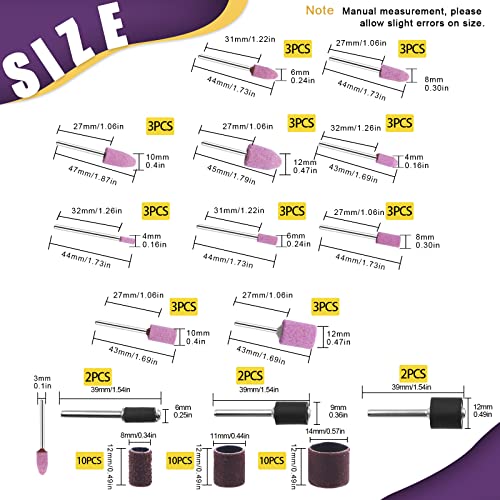
- 💿【What You Get】---------- You will get 136Pcs 1/8" Shank Grinding Stone Set, including 5 size of grinding wheels, namely 4mm, 6mm, 8mm,10mm and 12mm, in 2 shapes, cylindrical shapes and bullet shapes, each shape of size is 10pcs ,in total 100pcs of flap wheels. Come with 6pcs sanding bands in 3 diameters, 2pcs per size. And 30 pcs shank sanding drum in 3 diameters, 10pcs per size. in total 136pcs tools, sufficient quantity for your use and replacement need.
- 💿【High Quality Material】---------- The grinding stone made of high quality material red corundum sand, uniform, sharp and durable particles. It has good wear resistance which can be used for a long time. Universal 1/8" (3mm) shank made of high quality steel material, smooth and burr-free, strong and durable, can be used in drill presses and most rotary tools, can effectively remove rust from metal castings.
- 💿【Practical Sanding Drum Set 】---------- 30 reusable drum mandrel shanks, 3 diameters (1/4", 0.36", 0.49"), 10 of each size, universal and standard sizes for all rotary tools. Roller mandrels with self-expanding rubber pads keep the abrasive belt firmly close to the mandrel for a better finish. Sanding slevees are used for smooth surfaces and curved edges, polishing soft and hard materials such as home décor, artwork and woodwork.
- 💿【Various Size Tools】---------- Equipped with different sizes and shapes of polishing wheels, 50 cylindrical grinding bits and another 50 bullet shapes. These grinding and polishing bits are available in different sizes, with grinding bit diameters of 4mm, 6mm, 8mm, 10mm, 12mm, 10 of each size. 30 reusable roller mandrel shanks, 3 diameters (1/4", 0.36", 0.49"), 6pcs sanding bands in 3 diameters(0.35", 0.47" and 0.55"), universal and standard sizes for all rotary tools.The multiple sizes can better work for you.
- 💿【Wide Application】---------- 1/8" shank grinding stone set is an effective set of polishing tools for small area descaling and surface polishing of metallic and non-metallic materials. Can be used with electric grinders, hand drills and other rotary tools for polishing, grinding, trimming, carving and burring for molds, metals, plastics, wood, etc. Different models are available to suit different area grinding needs such as curved, flat and slotted surfaces.
| SELLER | SELLER SCORE | AMAZON FULFILLED | PRIME | FREE SHIPPING |
|---|---|---|---|---|
| Swpeet | 9.86 | Yes | Yes | Yes |

