#TOP1

Acoustic engineering is a multidisciplinary field that sits at the intersection of physics, mathematics, and practical design. Whether you are an architect looking to optimize room reverberation, a mechanical engineer tackling noise, vibration, and harshness (NVH) in automotive systems, or a student mastering wave equations, the literature available can be overwhelming. Choosing the right text is not just about finding the most advanced math. It is about finding the specific lens through which you view sound—be it through the analytical rigor of wave mechanics or the applied intuition of architectural acoustics. This guide is designed to help you navigate the specialized landscape of acoustic literature to find the resource that aligns with your professional or academic objectives.
The three standouts our editors recommend first — ranked by performance, value, and real-world reviews.



| SELLER | SELLER SCORE | AMAZON FULFILLED | PRIME | FREE SHIPPING |
|---|---|---|---|---|
| Amazon.com | 9.68 | Yes | Yes | Yes |

Audio Engineering 101: A Beginner's Guide to Music Production
| SELLER | SELLER SCORE | AMAZON FULFILLED | PRIME | FREE SHIPPING |
|---|---|---|---|---|
| Audible, Inc. (US) | 3.10 | No | No | No |
The steep learning curve of professional music software often stops talented musicians before they even record their first track. Audio Engineering 101: A Beginner's Guide to Music Production solves this technical barrier by translating complex sonic concepts into an accessible format. Since this is an Audible production, you can absorb these foundational principles while you are actually in the studio or commuting, making it a highly practical companion for hands-on learners. Instead of getting bogged down in dense textbooks, you get a streamlined audio experience that focuses on the essential mechanics of production. It is a smart way to build your technical confidence without needing to stare at a screen for hours on end.

Understanding Acoustics: An Experimentalist’s View of Sound and Vibration (Graduate Texts in Physics)
| SELLER | SELLER SCORE | AMAZON FULFILLED | PRIME | FREE SHIPPING |
|---|---|---|---|---|
| Amazon.com Services LLC | 0.00 | No | No | No |
A graduate student hunched over a complex wave interference pattern finally finds the clarity they need within these pages. This text moves beyond abstract mathematical theory to provide a grounded, practical perspective on how sound and vibration actually behave in physical environments. Because it is part of the Graduate Texts in Physics series, the depth of insight is substantial, making it a vital resource for anyone transitioning from classroom concepts to real-world experimental application. Since it is available as an immediate digital download, you can dive into these sophisticated acoustic principles the moment your research requires a deeper dive into vibrational mechanics. It serves as a bridge between pure physics and the tactile reality of experimental data.

| SELLER | SELLER SCORE | AMAZON FULFILLED | PRIME | FREE SHIPPING |
|---|---|---|---|---|
| Amazon.com | 9.68 | Yes | Yes | Yes |
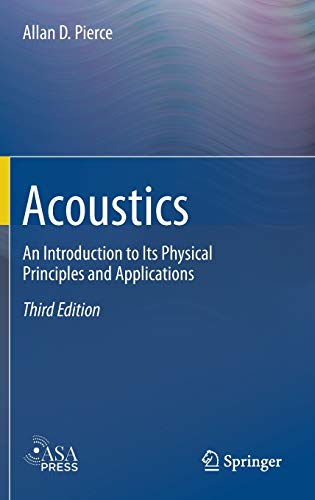
| SELLER | SELLER SCORE | AMAZON FULFILLED | PRIME | FREE SHIPPING |
|---|---|---|---|---|
| Amazon.com | 9.68 | Yes | Yes | Yes |
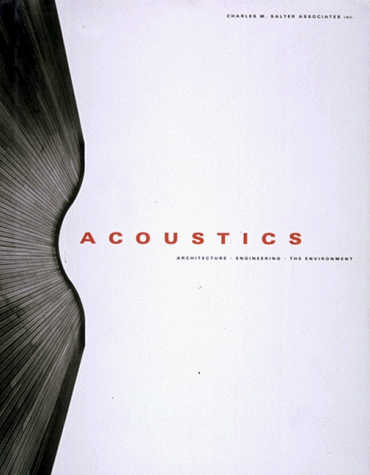
Acoustics - Architecture, Engineering, the Environment
| SELLER | SELLER SCORE | AMAZON FULFILLED | PRIME | FREE SHIPPING |
|---|---|---|---|---|
| Goodwill of Silicon Valley | 9.90 | No | No | No |
Architectural students and acoustic engineers require this specific text to bridge the gap between structural design and environmental soundscapes. William K Stout Pub has provided a copy that holds up remarkably well for a used volume, maintaining a good condition that makes it a reliable addition to a professional or academic library. It is rare to find specialized technical literature at this price point, especially when it covers such a critical intersection of engineering and spatial design. You won't find many resources that tackle the environmental impact of acoustics with this level of academic rigor. This book is a practical, cost-effective essential for anyone serious about mastering the science of how sound interacts with the built world.

| SELLER | SELLER SCORE | AMAZON FULFILLED | PRIME | FREE SHIPPING |
|---|---|---|---|---|
| Amazon.com | 9.68 | Yes | Yes | Yes |


| SELLER | SELLER SCORE | AMAZON FULFILLED | PRIME | FREE SHIPPING |
|---|---|---|---|---|
| InfiniteBooks_USA | 9.73 | No | No | No |

The most critical decision factor in selecting an acoustic engineering book is the level of mathematical sophistication required for your work. Acoustic engineering is heavily reliant on calculus, linear algebra, and differential equations. If you are a student or a researcher, you will likely require texts that delve into the Fourier transform, wave equations, and complex impedance. These books are often 'heavy' on derivations and are intended for deep theoretical mastery. Conversely, if you are a field technician or a practical designer, look for books that prioritize empirical data, measurement techniques, and applied formulas over long-form mathematical proofs. Using a high-level theoretical text to solve a practical installation problem can lead to 'analysis paralysis,' whereas a purely practical guide will leave you unable to troubleshoot complex wave interactions.
Acoustics is too broad to be covered comprehensively in a single volume without losing depth. You must identify which sub-sector of the field you are targeting. There are three primary categories of literature:
A common pitfall in engineering literature is selecting a book that is either too abstract or too anecdotal. A high-quality engineering text should provide a bridge between theory and application. Look for books that include case studies, real-world measurement data, and diagrams of experimental setups. For example, a book on sound insulation is significantly more valuable if it includes actual decibel reduction data from various material tests rather than just the theoretical formulas for transmission loss. The presence of practical exercises or 'problem sets' is also a strong indicator of a book's utility for long-term learning.
Acoustics is a field governed by strict international standards (such as ISO or ANSI). Because measurement protocols and digital processing technologies evolve, older textbooks may contain outdated methodologies for measuring sound pressure levels or describing noise metrics. When reviewing a book, check the publication date and ensure it references modern digital tools and current regulatory standards. While the fundamental physics of sound waves hasn't changed, the way we measure, model, and simulate them has undergone a revolution due to computational fluid dynamics (CFD) and advanced software modeling.
Quick answers about Acoustic Engineering Books before you buy.
Share of top-ranked products by brand, from our editorial analysis.
We've carried out a comprehensive analysis of 538 reviews on Acoustic Engineering Books, using our selection criteria to identify the best options in the engineering & transportation. Our findings reveal that most customers typically select Acoustic Engineering Books priced around $45.56, with top brands including mcgraw-hill education tab, routledge, dover publications, wiley, springer, brand: william k stout pub, academic press, audible and bobby owsinski media group and friesenpress.
Our team of expert editors reviewed these high-quality items and handpicked the top 8 Acoustic Engineering Books for your consideration. We've also done extensive research on numerous sellers, identifying the best ones in the engineering & transportation category — including amazon.com, itemspopularsonlineaindemand, goodwill of silicon valley, infinitebooks_usa and audible, inc. (us) and amazon.com services llc.
We are dedicated to assisting our users in finding the right engineering Products based on their needs, saving them considerable time when choosing which Acoustic Engineering Books to buy. We take pride in the number of satisfied users we've helped through our thorough and insightful reviews.
Compare the top 8 picks at a glance — select a column to sort.


