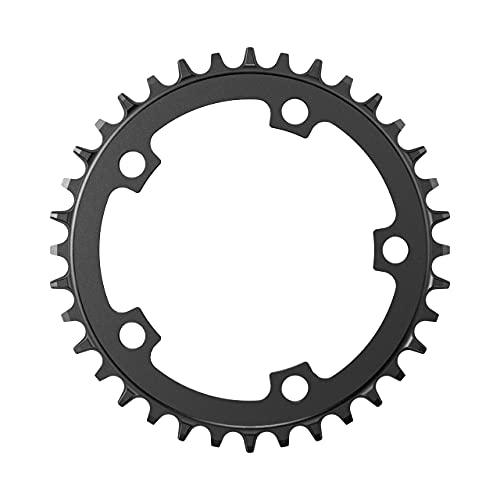
Understanding Tooth Count and Gear Ratios
The most fundamental decision in selecting a chainring is the tooth count. This number directly dictates your gear inches—how much distance the bike travels with each pedal stroke. For road cyclists, a larger chainring (such as 52T or 54T) provides the high-speed capability needed for descents and fast flats, while smaller rings (46T or 48T) facilitate easier climbing. For mountain bikers and gravel riders, the trend has shifted toward 'narrow-wide' single chainring setups, typically ranging from 30T to 34T, to prioritize traction and simplicity over top-end speed. Before purchasing, always calculate how a change in tooth count will affect your current cassette compatibility. A massive jump in ring size may require a larger cassette to maintain a logical gear progression.
Bolt Circle Diameter (BCD) and Mounting Patterns
You cannot simply pick any chainring that fits your aesthetic preference. It must match your crankset's mounting pattern. The Bolt Circle Diameter (BCD) is the measurement of the diameter of the circle formed by the bolt holes. Common patterns include 110mm, 130mm, or 140mm for road cranks, and various specific measurements for mountain bike cranks. Furthermore, you must distinguish between 'bolt-on' rings, which require separate chainring bolts, and 'direct mount' rings, which lock directly onto the crank arm via a proprietary interface. Attempting to force a BCD mismatch will lead to catastrophic component failure, so verify your crankset's technical specifications meticulously before ordering.
Material Composition: Weight vs. Durability
Chainrings are typically manufactured from aluminum, steel, or occasionally titanium. Aluminum is the industry standard for most riders, offering an excellent balance of lightweight performance and sufficient rigidity. High-end aluminum rings are often CNC-machined to reduce weight while maintaining structural integrity. Steel chainrings, while heavier, are significantly more resistant to the abrasive forces of grit and mud, making them a preferred choice for budget-conscious commuters or heavy-duty touring cyclists. If you are racing at an elite level, you might look for premium alloys that offer maximum stiffness to prevent 'chain suck' or lateral flex under high wattage.
If you are moving to a 1x (single chainring) drivetrain, the 'narrow-wide' tooth profile is non-negotiable. This technology uses alternating thick and thin teeth to 'lock' the chain in place, preventing it from bouncing off the ring on rough terrain. However, if you are running a traditional 2x or 3x setup, you must ensure the chainring is designed for multi-ring shifting. Rings designed for single-ring use lack the specific tooth shaping required to facilitate smooth upshifts and downshifts via a front derailleur. Always match the ring's profile to your intended shifting configuration to avoid noisy, hesitant, or failed gear changes.
Wear Resistance and Longevity
The interface between your chain and your chainring is a high-friction zone. To extend the life of your entire drivetrain, look for rings that feature surface hardening treatments or specialized coatings. A high-quality chainring should maintain its tooth shape over hundreds of miles. If the teeth begin to look like 'shark fins' (tapered and pointed), the ring is worn and will begin to skip under load. Investing slightly more in a premium, treated aluminum ring often pays for itself by preventing premature wear on your much more expensive chain and cassette.