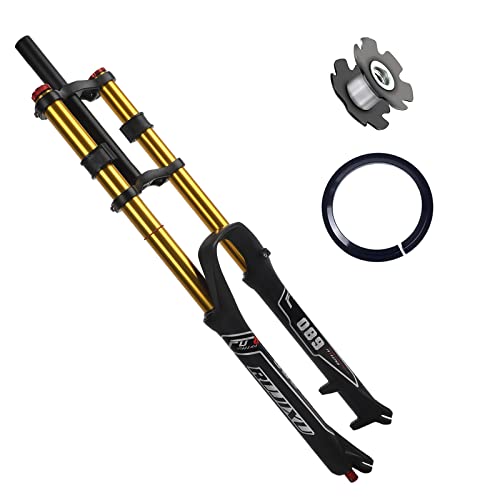
Determine Your Intended Terrain and Travel Requirements
The first and most vital step in selecting a fork is matching the 'travel'—the distance the fork compresses—to your riding style. If you are primarily a cross-country (XC) rider focused on efficiency and climbing, you should look for shorter travel lengths (typically 80mm to 100mm). These forks are designed to be lightweight and stiff, preventing 'bobbing' when you pedal hard. Conversely, if your passion lies in enduro or downhill riding, you need longer travel (150mm to 180mm) to soak up large drops and heavy impacts. Choosing a fork with too much travel for your frame can negatively affect your bike's geometry, making it feel 'slack' and potentially unstable, while too little travel will leave you feeling harsh on technical descents.
Understand Damping Systems: Coil vs. Air
The mechanism that controls how the fork rebounds after a hit is where the real magic happens. You will generally choose between two main types: Air springs and Coil springs. Air forks are the industry standard for modern versatility. By adjusting the air pressure via a shock pump, you can fine-tune the spring rate to your specific body weight. They are also significantly lighter and offer more progressive ramping. Coil forks, on the other hand, provide a much more linear and 'supple' feel. They are incredibly reliable and require less maintenance, making them a favorite for heavy-hitting riders or those who prefer a consistent, predictable feel regardless of temperature changes. However, they are much heavier and harder to tune for specific weights.
Evaluate Steerer Tube and Axle Standards
Before making a purchase, you must verify compatibility with your existing frame. There are two main areas of concern: the steerer tube and the axle interface. Most modern high-performance bikes use a tapered steerer tube (wider at the bottom), which provides superior steering precision and stiffness. Older or entry-level frames might still use straight steerer tubes. Furthermore, check your axle standard. Most performance-oriented forks utilize a 'thru-axle' system (such as 15x110mm Boost), which provides much greater lateral stiffness than traditional quick-release skewers. An incompatible axle or steerer tube will render the fork useless for your specific build.
Stanchion Diameter and Stiffness
The thickness of the upper tubes, known as stanchions, directly impacts the fork's rigidity. Thicker stanchions (such as 34mm or 36mm diameters) are more resistant to twisting under heavy braking or when navigating rock gardens. If you are a heavier rider or an aggressive trail rider, opting for a fork with thicker stanchions will prevent that 'vague' or 'flexy' feeling in corners. However, keep in mind that thicker stanchions and more robust lowers often come with a slight weight penalty. Finding the 'sweet spot' between weight savings and structural integrity is the hallmark of a smart upgrade.
Maintenance and Serviceability
A suspension fork is a precision instrument with moving seals and internal oil. When choosing a model, consider how easy it is to service. Look for forks that offer easy access to oil changes and seal replacements. A fork that is difficult to maintain will eventually lose its damping effectiveness, leading to a harsh ride and potential internal damage. High-quality bushings and durable seal designs are indicators of a fork that will remain performant over hundreds of miles of trail abuse.