#TOP1

Whether you are a professional librarian managing a university archive, a collector organizing a private rare book room, or a hobbyist building a personal digital library, the method you choose to catalog your collection determines your future ease of access. Cataloging is not merely about making a list. It is about creating a searchable, scalable, and durable metadata system. Choosing the right tools and methodologies requires a balance between granular detail and practical efficiency. This guide explores the essential considerations for selecting cataloging resources and software to ensure your collection remains organized for years to come.
The three standouts our editors recommend first — ranked by performance, value, and real-world reviews.


| SELLER | SELLER SCORE | AMAZON FULFILLED | PRIME | FREE SHIPPING |
|---|---|---|---|---|
| Amazon.com | 9.68 | Yes | Yes | Yes |


| SELLER | SELLER SCORE | AMAZON FULFILLED | PRIME | FREE SHIPPING |
|---|---|---|---|---|
| Amazon.com | 9.68 | Yes | Yes | Yes |


| SELLER | SELLER SCORE | AMAZON FULFILLED | PRIME | FREE SHIPPING |
|---|---|---|---|---|
| WhitePaper Books | 9.89 | No | No | No |


| SELLER | SELLER SCORE | AMAZON FULFILLED | PRIME | FREE SHIPPING |
|---|---|---|---|---|
| Amazon.com | 9.68 | Yes | Yes | Yes |


| SELLER | SELLER SCORE | AMAZON FULFILLED | PRIME | FREE SHIPPING |
|---|---|---|---|---|
| UBERTY.LLC | 9.88 | No | No | No |
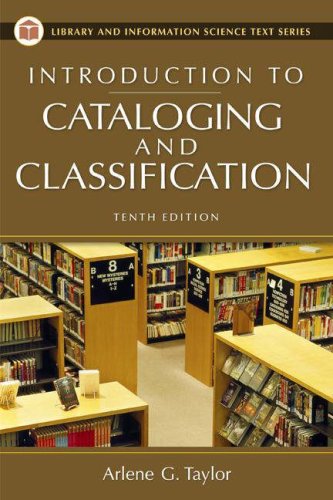

Introduction to Cataloging and Classification (Library Science Text Series)
| SELLER | SELLER SCORE | AMAZON FULFILLED | PRIME | FREE SHIPPING |
|---|---|---|---|---|
| Blue Vase Books | 9.92 | No | No | No |
Most people assume library science is just about shelving books, but this text reveals the complex architecture required to make information actually discoverable. This specific volume from the Libraries Unlimited series serves as a foundational pillar for anyone serious about mastering the technical nuances of organization. Since this is a used copy, you are getting a significant discount on essential academic knowledge without sacrificing the core educational value. It arrives in good condition, which is vital for a study guide you'll likely be flipping through frequently during long research sessions. At under nine dollars, it is an incredibly accessible entry point into the professional world of information management and systematic classification.


| SELLER | SELLER SCORE | AMAZON FULFILLED | PRIME | FREE SHIPPING |
|---|---|---|---|---|
| Amazon.com | 9.68 | Yes | Yes | Yes |


| SELLER | SELLER SCORE | AMAZON FULFILLED | PRIME | FREE SHIPPING |
|---|---|---|---|---|
| Amazon.com | 9.68 | Yes | Yes | Yes |

| SELLER | SELLER SCORE | AMAZON FULFILLED | PRIME | FREE SHIPPING |
|---|---|---|---|---|
| Poirinc | 4.71 | Yes | Yes | Yes |

| SELLER | SELLER SCORE | AMAZON FULFILLED | PRIME | FREE SHIPPING |
|---|---|---|---|---|
| Apex_media🍏 | 9.87 | Yes | Yes | Yes |


| SELLER | SELLER SCORE | AMAZON FULFILLED | PRIME | FREE SHIPPING |
|---|---|---|---|---|
| Amazon.com | 9.68 | Yes | Yes | Yes |

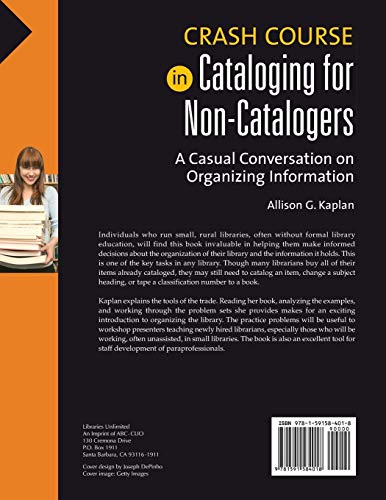

Crash Course in Cataloging for Non-Catalogers: A Casual Conversation on Organizing Information
| SELLER | SELLER SCORE | AMAZON FULFILLED | PRIME | FREE SHIPPING |
|---|---|---|---|---|
| Amazon.com | 9.68 | Yes | Yes | Yes |
Information overload becomes a nightmare when you lack the structural framework to organize it effectively. Bloomsbury Academic addresses this exact chaos with a title that promises a much-needed bridge between complex library science and everyday utility. This book functions as a casual, approachable guide for anyone thrown into a data management role without formal training. Instead of drowning in dense jargon, you get a conversational deep dive into the mechanics of organization. Since this specific copy is a used book in good condition, it offers a practical way to access these professional insights without the steep price tag of a brand-new academic text. It is a vital resource for anyone needing to make sense of information silos.
| SELLER | SELLER SCORE | AMAZON FULFILLED | PRIME | FREE SHIPPING |
|---|---|---|---|---|
| Amazon.com | 9.68 | Yes | Yes | Yes |


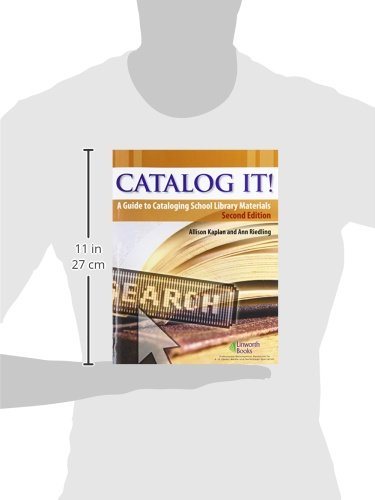
Catalog It!: A Guide to Cataloging School Library Materials (2nd Edition)
| SELLER | SELLER SCORE | AMAZON FULFILLED | PRIME | FREE SHIPPING |
|---|---|---|---|---|
| Super Book Sales | 9.86 | No | No | No |
The slightly worn edges of this second edition tell you immediately that this is a working manual designed for real-world library environments. Linworth Publishing has crafted a practical roadmap for anyone tasked with the meticulous job of organizing school library collections. Since this is a used copy in good condition, it offers a much more accessible entry point for librarians or students on a budget who need authoritative guidance without the premium price tag of a brand-new textbook. It functions less like a dry academic tome and more like a reliable desk companion that you can pull down whenever a tricky cataloging question arises. It is a solid, functional resource that prioritizes utility over pristine aesthetics.


Practical Cataloging: AACR2, RDA and MARC21
| SELLER | SELLER SCORE | AMAZON FULFILLED | PRIME | FREE SHIPPING |
|---|---|---|---|---|
| more-than-words | 9.87 | No | No | No |
Most library science professionals would tell you that mastering metadata standards is a nightmare, yet this specific guide makes the complex transition between systems feel surprisingly manageable. Practical Cataloging serves as a vital bridge for anyone navigating the nuances of AACR2, RDA, and MARC21 without feeling overwhelmed by technical jargon. Since this particular copy is a used book in good condition, it offers an incredibly accessible entry point into high-level bibliographic control. It is the kind of essential reference that belongs on the desk of every cataloger, providing the structural clarity needed to organize collections accurately. Even as a pre-owned volume, the core instructional value remains intact for students and seasoned librarians alike.
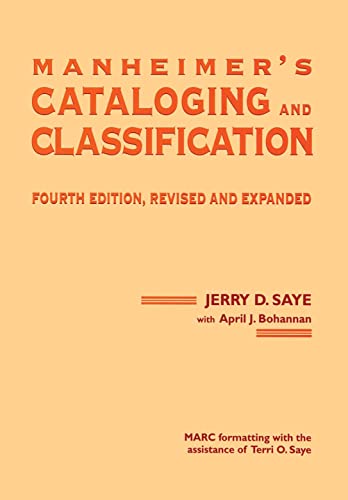

Manheimer's Cataloging and Classification, Revised and Expanded (Books in Library and Information Science Series)
| SELLER | SELLER SCORE | AMAZON FULFILLED | PRIME | FREE SHIPPING |
|---|---|---|---|---|
| ChokoFlan Group | 5.40 | Yes | Yes | Yes |
Manheimer's Cataloging and Classification is a definitive cornerstone for anyone serious about library and information science. This revised and expanded edition from CRC Press serves as an essential technical guide, offering the depth required for professional-grade organization and metadata management. While this particular copy is a used book, it arrives in good condition, making it a much more accessible way to acquire such a specialized academic resource. It is the kind of foundational text that stays on your reference shelf for years, providing the structural logic necessary for complex bibliographic work. Whether you are a student or a seasoned librarian, having this level of detail at your fingertips is indispensable for maintaining accuracy in modern collections.

The first decision factor is determining which standard your collection requires. If you are working in a professional or academic setting, you will likely need resources that adhere to international standards such as MARC (Machine-Readable Cataloging) or RDA (Resource Description and Access). These standards ensure that your data can be exchanged with other libraries globally. However, if you are a private collector, these standards may be overkill. For personal collections, you might prefer more intuitive systems like Dublin Core or even a simplified custom schema that focuses on metadata relevant to your specific interests, such as provenance, condition, or binding type.
When selecting a cataloging solution, consider the volume of your collection. A system that works for fifty books may become a bottleneck when you reach five thousand. Look for tools that support bulk importing via CSV or XML files, as manually entering every field for a large collection is prone to error and exhaustion. Furthermore, examine the 'searchability' of the resulting catalog. A high-quality cataloging tool should allow you to filter by multiple parameters simultaneously—such as author, publication year, and genre—without significant lag or complex syntax.
A common pitfall in cataloging is over-complicating the entry process. You must decide how much 'depth' you actually need. Do you need to track every single physical attribute, such as paper acidity, marginalia, or specific trim sizes? Or is a simple title, author, and ISBN enough? If you choose a high-depth system, ensure the interface is user-friendly. The best cataloging resources provide pre-populated data fields (often via ISBN lookups) to reduce manual typing, while still allowing you to add custom notes for unique or antique volumes that lack standard identifiers.
Decide whether your catalog should live locally or in the cloud. Localized software offers superior privacy and works without an internet connection, making it ideal for sensitive or highly private collections. Cloud-based cataloging tools, however, offer the advantage of multi-device synchronization. This allows you to update your catalog on a mobile device while standing in a bookstore or browsing an auction, ensuring your records are always current. If you opt for a digital-first approach, ensure the system allows for regular data backups in a non-proprietary format, so you are never locked into a single software provider.
While most modern cataloging is digital, many collectors still find value in physical reference books. If you are dealing with antiquarian books, look for guides that specialize in bibliography and descriptive cataloging. These resources teach you how to identify editions, printings, and points of issue—details that a standard database might miss. The ideal setup often combines a robust digital database for daily management with specialized physical references for deep-dive authentication and scholarly research.
Quick answers about Cataloging Books before you buy.
Share of top-ranked products by brand, from our editorial analysis.
We've carried out a comprehensive analysis of 52 reviews on Cataloging Books, using our selection criteria to identify the best options in the politics & social sciences. Our findings reveal that most customers typically select Cataloging Books priced around $43.89, with top brands including rowman & littlefield publishers, bloomsbury academic, independently published, libraries unlimited, brand: scarecrow press, brand: libraries unlimited, crc press, brand: linworth publishing and ala neal-schuman and ala editions.
Our team of expert editors reviewed these high-quality items and handpicked the top 16 Cataloging Books for your consideration. We've also done extensive research on numerous sellers, identifying the best ones in the politics & social sciences category — including apex_media🍏, amazon.com, whitepaper books, uberty.llc, blue vase books, chokoflan group, super book sales and more-than-words and poirinc.
We are dedicated to assisting our users in finding the right asins Products based on their needs, saving them considerable time when choosing which Cataloging Books to buy. We take pride in the number of satisfied users we've helped through our thorough and insightful reviews.
Compare the top 16 picks at a glance — select a column to sort.


