

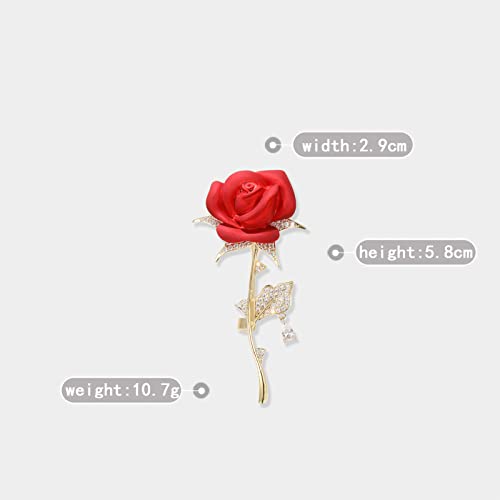

Qeehir Rose Brooch Pins For Women,Rose Pin Flower Brooch Pins Decorative Garment Dress Jewelry With Gift Box For Women Girls,Flower Brooch For Wedding Birthday Valentine's Day
QEEHIR
- 【Roses will always represent a declaration of love】 Roses have always been revered as an eternal symbol of love, beauty and equality. Red roses symbolize love and romance, making them the perfect Valentine's Day gift. A single rose symbolizes love at first sight. Two roses symbolize shared and deep love. Three roses means "I love you".
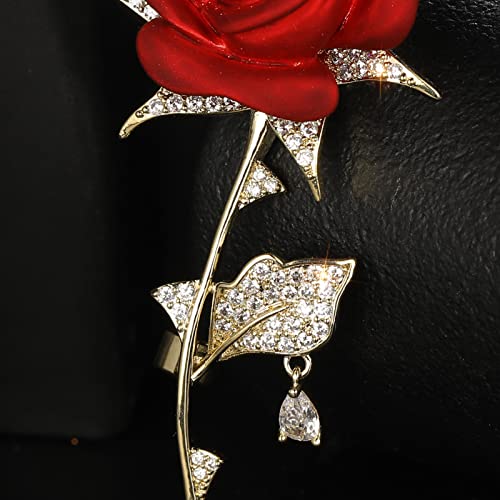
- 【Exquisite design details to love】 This brooch highly restores the warmth and gracefulness of the rose in bloom. The red flowers are sandblasted in Italy, the leaves are appropriately inlaid with 80 zirconium stones, dangling with one main stone, and the branches are plated in rose gold, with a full form and strong texture. The entire flower is beautifully shaped, with exquisite craftsmanship, exquisite details and outstanding texture.
- 【First-class quality and craftsmanship】 This brooch is made of sturdy copper alloy, about 6.0 cm (2.36 in) high, about 3.1 cm (1.22 in) wide, weighing about 11.3 grams (0.024 lb), worn on the body, exquisite and gorgeous, electroplated 18K gold, with excellent resistance to oxidation, sturdiness and reliability, can shine for a long time without losing its luster.
- 【The best gift for your favorite person】 It is perfect for your wife and girlfriend, a great Valentine's Day gift, of course, birthdays and anniversaries are also the best choice, as long as you want to say "I love you", it is more direct and more convincing than any other gift, it is suitable with a variety of styles of clothing. Love is a bold statement. Believe me, she is waiting for your warm confession!
- 【Hassle-free shopping experience, lightning returns】 QEEHIR is a fashion jewelry company based in China,with its own team of designers and years of professional jewelry manufacturing experience, with unique designs and high quality. We are committed to providing qualified products and satisfactory customer service. If you are not completely satisfied with our brooches, you can get a hassle-free return or full refund without any problem.
| SELLER | SELLER SCORE | AMAZON FULFILLED | PRIME | FREE SHIPPING |
|---|---|---|---|---|
| Qeehir | 5.27 | Yes | Yes | Yes |

