#TOP1

The intersection of healthcare and engineering is one of the most rapidly evolving sectors in the modern world. For clinicians, biomedical engineers, and healthcare administrators, staying current requires more than just reading medical journals. It requires a deep dive into the literature governing the hardware, software, and regulatory frameworks that power modern medicine. Choosing the right medical technology books is a strategic decision that can bridge the gap between theoretical science and practical, life-saving application.
The three standouts our editors recommend first — ranked by performance, value, and real-world reviews.


| SELLER | SELLER SCORE | AMAZON FULFILLED | PRIME | FREE SHIPPING |
|---|---|---|---|---|
| DEEP RED SEA | 4.35 | No | No | No |
| SELLER | SELLER SCORE | AMAZON FULFILLED | PRIME | FREE SHIPPING |
|---|---|---|---|---|
| Amazon.com | 9.68 | Yes | Yes | Yes |

| SELLER | SELLER SCORE | AMAZON FULFILLED | PRIME | FREE SHIPPING |
|---|---|---|---|---|
| Amazon.com | 9.68 | Yes | Yes | Yes |


| SELLER | SELLER SCORE | AMAZON FULFILLED | PRIME | FREE SHIPPING |
|---|---|---|---|---|
| Amazon.com | 9.68 | Yes | Yes | Yes |

| SELLER | SELLER SCORE | AMAZON FULFILLED | PRIME | FREE SHIPPING |
|---|---|---|---|---|
| Amazon.com Services LLC | 0.00 | No | No | No |

| SELLER | SELLER SCORE | AMAZON FULFILLED | PRIME | FREE SHIPPING |
|---|---|---|---|---|
| Amazon.com | 9.68 | Yes | Yes | Yes |

| SELLER | SELLER SCORE | AMAZON FULFILLED | PRIME | FREE SHIPPING |
|---|---|---|---|---|
| Amazon.com | 9.68 | Yes | Yes | Yes |

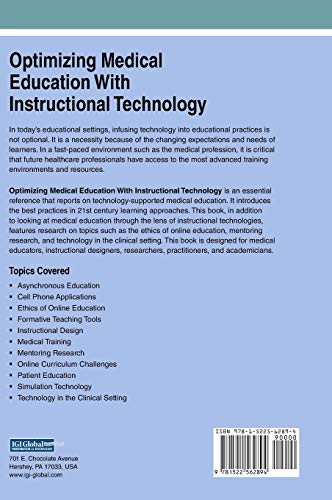
Optimizing Medical Education With Instructional Technology (Advances in Medical Education, Research, and Ethics)
| SELLER | SELLER SCORE | AMAZON FULFILLED | PRIME | FREE SHIPPING |
|---|---|---|---|---|
| Amazon.com | 9.68 | Yes | Yes | Yes |
Optimizing Medical Education With Instructional Technology stands as a definitive cornerstone for academic researchers and healthcare educators navigating the digital shift. This volume from Medical Information Science Reference dives deep into the intersection of pedagogy and modern tech, making it an essential acquisition for anyone serious about the future of clinical training. While the price point reflects its specialized nature, the depth of insight regarding medical research and ethics justifies the investment for institutional libraries or dedicated professionals. It moves beyond surface-level tech discussions to address the complex ethical frameworks required in high-stakes medical learning environments. If you are looking to bridge the gap between traditional instruction and cutting-edge digital tools, this text provides the necessary roadmap.

In the Blood: How Two Outsiders Solved a Centuries-Old Medical Mystery and Took On the US Army
| SELLER | SELLER SCORE | AMAZON FULFILLED | PRIME | FREE SHIPPING |
|---|---|---|---|---|
| Amazon.com | 9.68 | Yes | Yes | Yes |
Imagine sitting in a quiet study, ready to lose yourself in a high-stakes battle between rogue investigators and a massive military institution. In the Blood delivers exactly that tension by chronicling how two outsiders managed to crack a medical enigma that had remained unsolved for centuries. This isn't just a dry history lesson. It is a gripping account of intellectual persistence and the courage required to challenge the US Army. The narrative weaves together complex medical science with a David-versus-Goliath struggle, making it a perfect companion for anyone who enjoys investigative true crime or historical medical dramas. It is a deeply compelling read that proves sometimes the most important discoveries come from those standing outside the establishment.


Clinical Chemistry: Principles, Techniques and Correlations
| SELLER | SELLER SCORE | AMAZON FULFILLED | PRIME | FREE SHIPPING |
|---|---|---|---|---|
| Emer06 | 7.47 | Yes | Yes | Yes |
Most medical students assume that mastering laboratory data is purely about memorizing formulas, but this Lippincott Williams Wilkins text proves it is actually about understanding the intricate correlations behind the numbers. This particular copy arrives in good condition, making it a reliable companion for anyone diving into the complexities of clinical chemistry. Instead of just presenting dry data, the book bridges the gap between technical laboratory methods and real-world patient outcomes. It is a dense resource, but the clarity of the principles provided makes the steep learning curve much more manageable for serious students. Since it is available as a used book, you can get this foundational knowledge without the heavy price tag typically associated with specialized medical literature.

Before investing in technical literature, you must identify your primary objective. Medical technology is a multidisciplinary field, and books are typically written from one of three distinct perspectives. If you are an engineer, you should seek texts focused on signal processing, biomechanics, and materials science. If you are a clinician, prioritize books that focus on the clinical application, integration, and interpretation of diagnostic tools. For those in management or law, look for literature centered on regulatory affairs, quality management systems, and the lifecycle of medical device development. Mixing these perspectives can lead to frustration if a book is too mathematically dense for a practitioner or too superficial for a developer.
One of the most common pitfalls in this category is purchasing a text that lacks the necessary depth for your specific role. A 'survey' book might provide a wonderful overview of the history of radiology, but it will not teach you how to design a pulse oximetry sensor. Look for indicators of technical rigor in the table of contents. High-quality technical books will include detailed derivations, circuit diagrams, algorithm pseudocode, or specific statistical methodologies. If you are looking to master a specific sub-field, ensure the book moves beyond conceptual descriptions and into the 'how-to' of implementation and troubleshooting.
In the medical technology sector, technology does not exist in a vacuum. It exists within a strict framework of safety and compliance. A high-quality technical book should not only explain how a device works but also touch upon the standards that govern its design and deployment. Look for references to international standards, risk management protocols, and validation processes. Books that ignore the regulatory landscape are often outdated or purely academic, failing to prepare the reader for the realities of bringing a medical product to market or operating within a hospital environment.
Because software-driven healthcare (SaMD) and AI-integrated diagnostics are moving at breakneck speed, the 'shelf life' of a medical technology book is shorter than that of a traditional biology textbook. When evaluating a title, check the publication date against the specific technology discussed. A book on imaging technology written five years ago may lack critical insights into deep learning-based reconstruction techniques. Always check if there are updated editions that address recent shifts in digital health, cybersecurity for medical devices, or new biocompatibility standards.
When selecting your next purchase, follow this logic: If your goal is immediate practical application in a lab or clinic, prioritize books with case studies and troubleshooting guides. If your goal is academic mastery, prioritize texts with extensive bibliographies and peer-reviewed foundations. If your goal is career advancement in the industry, prioritize books that bridge the gap between engineering design and regulatory approval.
Quick answers about Medical Technology Books before you buy.
Share of top-ranked products by brand, from our editorial analysis.
We've carried out a comprehensive analysis of 128 reviews on Medical Technology Books, using our selection criteria to identify the best options in the medical books. Our findings reveal that most customers typically select Medical Technology Books priced around $43.99, with top brands including cambridge university press, springer, cengage learning, f. a. davis company, academic press, independently published, skyhorse, crc press and medical information science reference and createspace independent publishing platform.
Our team of expert editors reviewed these high-quality items and handpicked the top 10 Medical Technology Books for your consideration. We've also done extensive research on numerous sellers, identifying the best ones in the medical books category — including amazon.com and deep red sea and amazon.com services llc.
We are dedicated to assisting our users in finding the right technology Products based on their needs, saving them considerable time when choosing which Medical Technology Books to buy. We take pride in the number of satisfied users we've helped through our thorough and insightful reviews.
Compare the top 10 picks at a glance — select a column to sort.


