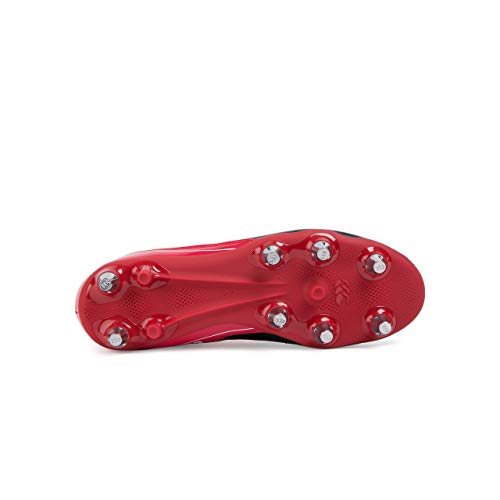
Understanding Stud Configuration and Surface Compatibility
The most critical decision factor for a rugby player is the stud pattern. Because the number 10 often operates in wide channels or high-traffic tactical areas, you must match your studs to the pitch conditions. For soft, muddy ground, you should look for long, metal-tipped studs that penetrate deep into the turf to prevent slipping during sudden changes of direction. However, if you frequently play on artificial turf or firm, dry ground, long metal studs can be dangerous and unstable. In those cases, a hybrid configuration or high-quality molded studs provide the necessary grip without the risk of ankle rolls or joint strain caused by 'stud lock' on hard surfaces.
Weight vs. Durability: The Playmaker’s Dilemma
As a playmaker, speed is your greatest asset. Many modern rugby boots utilize lightweight synthetic materials or ultra-thin kangaroo leather to reduce the weight on your feet, allowing for quicker footwork and less fatigue during the final twenty minutes of a match. However, there is a trade-off. Extremely lightweight boots often sacrifice the structural integrity needed for long-term durability. If you are a high-impact player who frequently engages in tackles, you might prefer a boot with a reinforced toe box and a more robust upper. For the pure tactical kicker, a lightweight boot with a stiffened soleplate is ideal, as it provides the energy transfer needed for long-distance punts.
The Importance of Soleplate Stiffness
For a fly-half, the soleplate is the foundation of your kicking game. A soleplate that is too flexible will absorb too much energy, making your kicks feel 'dead' and reducing distance. Conversely, a soleplate that is too rigid can lead to discomfort and potential injury during sprinting. Look for a boot that offers a 'tuned' stiffness—rigid enough in the forefoot to provide a stable striking surface for kicking, but with enough longitudinal flexibility to allow for a natural running gait. This balance ensures you can transition from a sprint to a tactical kick seamlessly.
Upper Material and Touch Sensitivity
The material of the boot's upper dictates how much 'feel' you have for the ball. Traditional leather boots offer unparalleled natural stretch and a soft touch, which is highly beneficial for players who rely on delicate ball control and precise passing. On the other hand, modern synthetic uppers are often engineered with textured patterns designed to improve grip on the ball in wet conditions. If you play in rainy climates, a synthetic upper that maintains its shape and provides consistent friction is a significant advantage for maintaining control during high-speed handling.
Fit and Lockdown
Finally, never overlook the importance of a secure lockdown. A rugby boot that allows your foot to slide internally will ruin your accuracy and increase the risk of blisters. Ensure the heel cup is deep and snug, and that the lacing system allows you to tighten the midfoot securely. A precise fit ensures that every movement of your foot is translated directly to the pitch, providing the stability required for those crucial split-second decisions in the number 10 role.