#TOP1

In the high-stakes world of materials science and metallurgical engineering, the margin for error is virtually non-existent. Whether you are sourcing high-purity alloys for aerospace applications, selecting specialized testing equipment for grain structure analysis, or procuring refractory materials for foundry work, your choice of materials and tools dictates the structural integrity of the final product. This guide is designed to help engineers and procurement specialists navigate the complex landscape of metallurgy-grade engineering supplies, ensuring that every component meets the rigorous mechanical, chemical, and thermal requirements of modern manufacturing.
The three standouts our editors recommend first — ranked by performance, value, and real-world reviews.
| SELLER | SELLER SCORE | AMAZON FULFILLED | PRIME | FREE SHIPPING |
|---|---|---|---|---|
| Amazon.com | 9.68 | Yes | Yes | Yes |


Engineers' Practical Databook: A Technical Reference Guide for Students and Professionals
| SELLER | SELLER SCORE | AMAZON FULFILLED | PRIME | FREE SHIPPING |
|---|---|---|---|---|
| Amazon.com | 9.68 | Yes | Yes | Yes |
Engineers' Practical Databook is an indispensable technical companion that distills complex data into a portable, high-utility format. Whether you are a student navigating rigorous coursework or a working professional in the field, having a reliable reference at your fingertips changes how you approach problem-solving. This guide functions as a mental shortcut, providing the essential formulas and constants required to move through calculations without constant digital searching. At its current price point, it offers significant value for anyone needing a physical anchor for technical information. It is the kind of resource that belongs in a toolkit or a backpack, serving as a bridge between theoretical classroom concepts and real-world application.

| SELLER | SELLER SCORE | AMAZON FULFILLED | PRIME | FREE SHIPPING |
|---|---|---|---|---|
| Amazon.com | 9.68 | Yes | Yes | Yes |

| SELLER | SELLER SCORE | AMAZON FULFILLED | PRIME | FREE SHIPPING |
|---|---|---|---|---|
| Amazon.com | 9.68 | Yes | Yes | Yes |
| SELLER | SELLER SCORE | AMAZON FULFILLED | PRIME | FREE SHIPPING |
|---|---|---|---|---|
| Amazon.com | 9.68 | Yes | Yes | Yes |


| SELLER | SELLER SCORE | AMAZON FULFILLED | PRIME | FREE SHIPPING |
|---|---|---|---|---|
| Kaplan North America | 7.24 | Yes | Yes | Yes |

The Physical Metallurgy of Steels (MCGRAW HILL SERIES IN MATERIALS SCIENCE AND ENGINEERING)
| SELLER | SELLER SCORE | AMAZON FULFILLED | PRIME | FREE SHIPPING |
|---|---|---|---|---|
| Silent Witnwss | 5.05 | Yes | Yes | Yes |
Metallurgical engineers and advanced materials science students require this specific text to bridge the gap between theoretical physics and practical steel production. This edition from the McGraw Hill Series in Materials Science and Engineering provides the deep technical rigor necessary for mastering complex alloy structures. While this particular copy is a used book, it remains in good condition, making it a much more accessible way to own a cornerstone academic resource. It is a heavy-duty reference that focuses on the fundamental properties and behaviors of steel, serving as a reliable companion for anyone working in high-stakes manufacturing or structural design. Investing in this volume means securing a foundational piece of scientific literature that stays relevant through years of professional practice.

| SELLER | SELLER SCORE | AMAZON FULFILLED | PRIME | FREE SHIPPING |
|---|---|---|---|---|
| Amazon.com | 9.68 | Yes | Yes | Yes |

| SELLER | SELLER SCORE | AMAZON FULFILLED | PRIME | FREE SHIPPING |
|---|---|---|---|---|
| Amazon.com | 9.68 | Yes | Yes | Yes |

| SELLER | SELLER SCORE | AMAZON FULFILLED | PRIME | FREE SHIPPING |
|---|---|---|---|---|
| Amazon.com | 9.68 | Yes | Yes | Yes |


| SELLER | SELLER SCORE | AMAZON FULFILLED | PRIME | FREE SHIPPING |
|---|---|---|---|---|
| Amazon.com | 9.68 | Yes | Yes | Yes |


| SELLER | SELLER SCORE | AMAZON FULFILLED | PRIME | FREE SHIPPING |
|---|---|---|---|---|
| Amazon.com | 9.68 | Yes | Yes | Yes |

Laser Sintering with Plastics: Technology, Processes, and Materials
| SELLER | SELLER SCORE | AMAZON FULFILLED | PRIME | FREE SHIPPING |
|---|---|---|---|---|
| Amazon.com | 9.68 | Yes | Yes | Yes |
Bridging the gap between theoretical additive manufacturing and practical industrial application is the primary mission of this technical deep dive. Hanser Publications has delivered a rigorous resource that moves past surface-level tutorials to tackle the actual physics and chemistry of laser sintering. Instead of just showing you how to run a machine, this text forces you to understand the complex relationship between polymer materials and the sintering process itself. It is an essential cornerstone for engineers and material scientists who need to troubleshoot print quality or optimize material selection for high-performance parts. While the technical depth is significant, the investment in this volume pays off by providing the foundational knowledge required to master plastic-based 3D printing workflows.

| SELLER | SELLER SCORE | AMAZON FULFILLED | PRIME | FREE SHIPPING |
|---|---|---|---|---|
| Goodwill Minnesota | 9.91 | No | No | No |

| SELLER | SELLER SCORE | AMAZON FULFILLED | PRIME | FREE SHIPPING |
|---|---|---|---|---|
| Amazon.com | 9.68 | Yes | Yes | Yes |
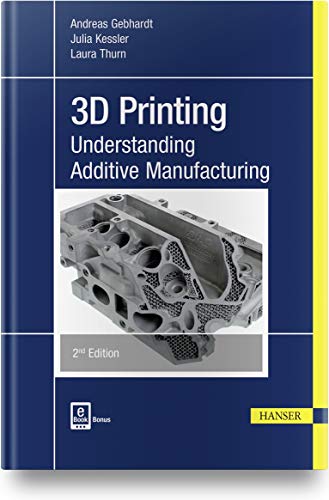
3D Printing 2E: Understanding Additive Manufacturing
| SELLER | SELLER SCORE | AMAZON FULFILLED | PRIME | FREE SHIPPING |
|---|---|---|---|---|
| Amazon.com | 9.68 | Yes | Yes | Yes |
After weeks of use diving into the complex world of additive manufacturing, I finally feel like I have a solid grasp on the technical nuances of the field. Hanser Publications has put together a comprehensive resource in 3D Printing 2E that moves beyond simple hobbyist tutorials to address the real meat of the industry. It is a substantial deep dive that bridges the gap between basic printing and professional-grade manufacturing processes. While the price point reflects its specialized nature, the depth of information makes it a worthwhile investment for anyone serious about mastering the mechanics behind the machines. This isn't just a manual. It is a foundational text for understanding how additive technology is reshaping modern production.

| SELLER | SELLER SCORE | AMAZON FULFILLED | PRIME | FREE SHIPPING |
|---|---|---|---|---|
| Amazon.com | 9.68 | Yes | Yes | Yes |

| SELLER | SELLER SCORE | AMAZON FULFILLED | PRIME | FREE SHIPPING |
|---|---|---|---|---|
| Amazon.com | 9.68 | Yes | Yes | Yes |

| SELLER | SELLER SCORE | AMAZON FULFILLED | PRIME | FREE SHIPPING |
|---|---|---|---|---|
| Amazon.com | 9.68 | Yes | Yes | Yes |


| SELLER | SELLER SCORE | AMAZON FULFILLED | PRIME | FREE SHIPPING |
|---|---|---|---|---|
| Basi6 International | 9.60 | No | No | No |

Uranium (Reviews in Mineralogy & Geochemistry)
| SELLER | SELLER SCORE | AMAZON FULFILLED | PRIME | FREE SHIPPING |
|---|---|---|---|---|
| Amazon.com | 9.68 | Yes | Yes | Yes |
A researcher hunched over a laboratory bench or a student diving into complex geochemical cycles will find this volume an essential companion. This specific edition of Uranium from the Reviews in Mineralogy & Geochemistry series serves as a deep dive into the elemental complexities that define modern earth sciences. Since this is a used copy, you should expect a well-loved academic texture, but it remains in good condition for serious study. It is the kind of specialized resource that bridges the gap between theoretical mineralogy and practical geochemistry. While it isn't a casual read, the depth of information provided by De Gruyter makes it a foundational piece for any professional or academic library focused on heavy element behavior.


SME Mining Engineering Handbook, 2 Volume Set (Second Edition)
| SELLER | SELLER SCORE | AMAZON FULFILLED | PRIME | FREE SHIPPING |
|---|---|---|---|---|
| Delaram | 4.30 | No | No | No |
The SME Mining Engineering Handbook stands as the definitive technical cornerstone for anyone serious about the complexities of modern mineral extraction. This second edition two-volume set provides an exhaustive deep dive into the engineering principles that drive the industry. Since this specific copy is a used book in good condition, you are getting a high-level professional resource without the steep price tag of a brand-new academic release. It functions as both a classroom essential and a reliable field reference, covering the breadth of the discipline with precision. While the physical condition reflects its previous ownership, the content remains an indispensable asset for engineers looking to master the technical nuances of mining operations.

The most critical factor in metallurgical procurement is the precision of the chemical specification. When selecting engineering materials, you cannot rely on generic labels like 'stainless steel' or 'aluminum alloy.' You must look for specific standardized grades (such as those defined by ASTM, ISO, or DIN) that dictate the exact percentage of alloying elements like chromium, nickel, molybdenum, or vanadium. These elements fundamentally alter the material's properties, such as corrosion resistance, hardness, and ductility. Always request a Mill Test Report (MTR) to verify that the chemical composition and mechanical properties align with your design specifications before committing to a large-scale purchase.
Beyond chemistry, how a material behaves under stress is paramount. Your selection process must prioritize key mechanical metrics: tensile strength, yield strength, elongation, and hardness (often measured via Rockwell or Brinell scales). For applications involving cyclic loading, fatigue resistance is the deciding factor. For high-temperature environments, creep resistance becomes the priority. If you are purchasing engineering tools, such as hardness testers or ultrasonic flaw detectors, ensure the device's precision and calibration standards are capable of measuring these specific properties within the tolerances required by your industry standards.
A material is more than its bulk composition. Its microstructure determines its performance. When sourcing engineering components, you must determine if the material is supplied in an annealed, normalized, quenched, or tempered state. A material that is 'as-cast' will behave very differently from one that has undergone rigorous thermomechanical processing. For precision engineering, look for suppliers who can guarantee grain size control and phase stability. If your work involves microscopy or failure analysis, ensure your inspection tools have the resolution necessary to distinguish between different phases, such as martensite versus austenite in steel.
Metallurgical engineering often occurs in hostile environments. Consider the pH levels, salinity, and oxidative potential of the operating environment. Selecting a material based solely on strength while ignoring its electrochemical potential can lead to catastrophic stress corrosion cracking or pitting. When evaluating materials for chemical processing or marine applications, prioritize those with proven passivation layers or specialized coatings. If purchasing testing equipment, ensure the sensors and probes are chemically resistant to the mediums being analyzed.
To make an informed decision, follow this hierarchy: First, define the absolute minimum mechanical and chemical thresholds required for safety. Second, identify the environmental stressors (heat, acid, vibration). Third, evaluate the cost-to-performance ratio—often, a slightly more expensive alloy with superior fatigue life is more economical over the product lifecycle than a cheaper material prone to premature failure. Finally, prioritize vendors who provide comprehensive traceability documentation, as this is the bedrock of quality assurance in metallurgy.
Quick answers about Metallurgy Materials Engineering before you buy.
Share of top-ranked products by brand, from our editorial analysis.
We've carried out a comprehensive analysis of 7 reviews on Metallurgy Materials Engineering, using our selection criteria to identify the best options in the engineering & transportation. Our findings reveal that most customers typically select Metallurgy Materials Engineering priced around $116.66, with top brands including read books, ppi a kaplan company, springer, mcgraw-hill education, butterworth-heinemann, lap lambert academic publishing, createspace independent publishing platform, fox chapel publishing and wspc and independently published.
Our team of expert editors reviewed these high-quality items and handpicked the top 22 Metallurgy Materials Engineering for your consideration. We've also done extensive research on numerous sellers, identifying the best ones in the engineering & transportation category — including amazon.com, kaplan north america, goodwill minnesota and silent witnwss and basi6 international.
We are dedicated to assisting our users in finding the right engineering Products based on their needs, saving them considerable time when choosing which Metallurgy Materials Engineering to buy. We take pride in the number of satisfied users we've helped through our thorough and insightful reviews.
Compare the top 22 picks at a glance — select a column to sort.