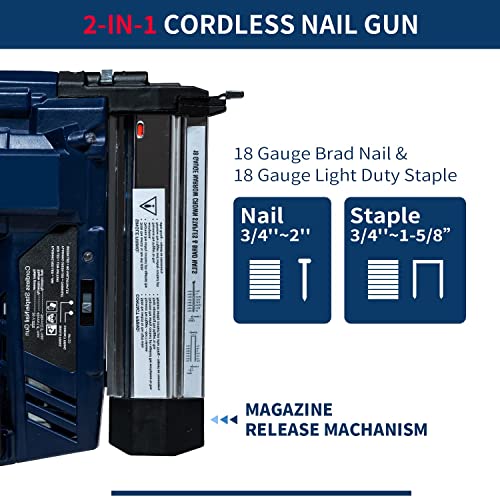
Understanding Gauge and Fastener Versatility
The most critical specification to evaluate is the nail gauge. Most brad nailers in this category operate in the 18-gauge range. This gauge is the 'sweet spot' for most interior projects, providing enough holding power for baseboards and crown molding while remaining thin enough to minimize visible damage to the wood surface. When shopping, consider the depth of the fastener. A high-quality brad nailer should allow you to drive nails flush into various wood densities, from soft pine to harder hardwoods, without the need for excessive pre-drilling.
Power Source: Corded vs. Cordless
The decision between a corded electric model and a cordless battery-operated model often dictates how you will actually use the tool. Corded models offer consistent, unrelenting power and are ideal for stationary workshop tasks where you don't want to worry about battery life. However, they tether you to an outlet. Cordless models offer unparalleled mobility, making them superior for installing trim around a large room or working in attic spaces. If you opt for cordless, pay close attention to the battery platform compatibility. Staying within a consistent ecosystem ensures you aren't constantly hunting for proprietary chargers.
Drive Mechanism and Depth Adjustment
A standout feature in a premium brad nailer is a precise depth-of-drive adjustment. This mechanical dial allows you to control exactly how deep the nail sits in the substrate. If the setting is too shallow, the nail will protrude. If it is too deep, you risk 'blowout' or cratering the wood. Look for models with a clear, easy-to-read adjustment scale. Additionally, consider the trigger mechanism. A sequential trigger (requiring a pull for every shot) offers much higher precision for delicate work, whereas a contact trip mechanism (where the nose must be pressed against the wood) allows for faster, repetitive firing.
Ergonomics and Weight Distribution
Brad nailers are often used overhead or in awkward angles while installing molding. A heavy, unbalanced tool will lead to hand fatigue and decreased accuracy. Look for designs that feature rubberized grips and a balanced center of gravity. The weight should be substantial enough to feel sturdy during high-speed firing, but light enough to maneuver comfortably for extended periods. A slim profile is also beneficial, as it allows you to get the nose of the tool into tight corners and narrow crevices without hitting your knuckles against the workpiece.