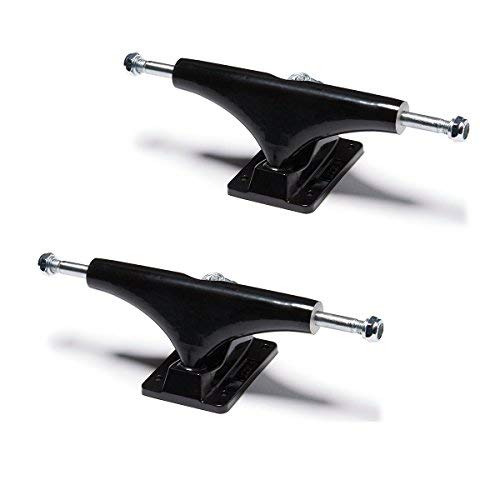
Understanding Truck Geometry and Width
The most critical factor in selecting trucks is the axle width. A common mistake is pairing trucks that are too narrow or too wide for the deck. For optimal stability and control, your truck axle should ideally be roughly the same width as your skateboard deck. If your trucks are significantly narrower than your board, you create 'foot overhang,' which makes the board feel unstable and increases the risk of catching a toe on the ground during turns. Conversely, trucks that are much wider than the deck can feel cumbersome and heavy. When shopping, always measure your deck width in millimeters and match it to the corresponding truck size to ensure a balanced center of gravity.
Kingpin Orientation: Traditional vs. Reverse Kingpin
The orientation of the kingpin—the large bolt that holds the truck together—drastically changes the ride quality. Traditional Kingpin (TKP) trucks are the industry standard for street skating. They are lower to the ground, providing a stable platform for grinds and technical flip tricks. They offer a predictable, snappy turn that is essential for pop. On the other hand, Reverse Kingpin (RKP) trucks are typically found on longboards or cruiser setups. These trucks are designed for deep, surf-like carving and high-speed stability. If your goal is park or street skating, stick to TKP. If you are looking for downhill speed or relaxed cruising, RKP is your best bet.
Weight and Material Composition
Trucks are generally constructed from cast aluminum, but the weight of that aluminum matters. Lighter trucks allow for faster ollies and more agile transitions, which is a massive advantage for technical street skaters. However, ultra-lightweight trucks can sometimes feel 'twitchy' or unstable at higher speeds. Heavier, more robust trucks offer a planted, solid feel that is preferred by transition and bowl skaters who need to absorb the impact of large drops and high-speed carves. Look for high-quality alloys that offer a balance of durability and manageable weight to prevent your setup from feeling sluggish.
Bushings and Turning Feel
Often overlooked, the bushings—the small urethane cylinders that sit in the hanger—are the primary component that determines how much resistance you feel when leaning. Bushings come in various hardness levels (durometer). If you are a heavier skater, you will need harder bushings to prevent the truck from feeling too 'floppy.' If you are a lighter skater, soft bushings will allow you to turn with minimal effort. Many riders choose to upgrade their bushings separately from the trucks to fine-tune their turning radius and responsiveness.
The Importance of the Hanger and Baseplate
The hanger is the part that holds the wheels, and the baseplate is what attaches to the deck. For high-impact skating, look for a reinforced baseplate and a hanger that is precision-machined or high-quality cast to prevent bending under pressure. A well-designed hanger will have a specific 'turn geometry' that dictates whether the truck feels loose and surfy or tight and controlled. Always consider how the truck's geometry complements your personal riding flow.