Material Composition and Durability
The first decision factor is the material of the snap itself. Most professional-grade snaps are categorized into three groups: brass, stainless steel, and plated alloys. Brass is the industry standard for upholstery and outdoor gear because it is naturally resistant to corrosion and offers a slight flexibility that prevents the metal from cracking under repeated tension. If your project involves marine environments or constant exposure to moisture, prioritize high-grade stainless steel. While more difficult to set, stainless steel offers unmatched longevity. Avoid cheap plated plastics or low-grade zinc alloys if your project requires frequent opening and closing, as these tend to fatigue and lose their 'spring' over time.
Stud and Socket Sizing
One of the most common mistakes in fastener selection is misjudging the diameter of the stud and socket. Snaps are not one-size-fits-all. They are scaled to the weight of the material they are intended to hold. For lightweight apparel, you will look for smaller diameters that minimize bulk. However, for heavy leather or multi-layered marine vinyl, you need larger, more robust diameters. When selecting your snaps, always measure the thickness of your material stack. A snap that is too small for a thick material will fail to grip, while a snap that is too large for thin fabric will cause the material to bunch and pucker around the base.
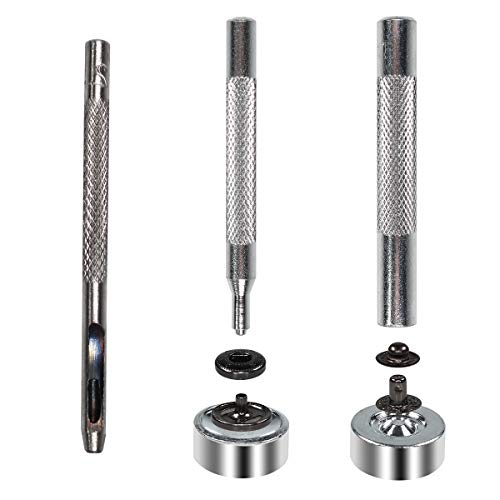
How you intend to install the snaps is just as important as the snaps themselves. There are two primary ways to approach installation: hand-setting with a plier-style tool or using a heavy-duty bench press. If you are doing small-scale hobbyist work, a handheld setter might suffice, but for professional results—especially with Innetoc-style hardware—a press is highly recommended. A press provides even, vertical pressure that ensures the cap, stud, and socket are perfectly aligned. If the alignment is even a fraction of a millimeter off, the snap will feel 'mushy' or fail to lock entirely. Check if the snaps you are purchasing are compatible with your existing die sets to avoid unnecessary tool investments.
Fastening Strength and Tension
The 'pull strength' of a snap is a critical metric for functional gear. If you are designing a bag closure or a protective cover, you need a snap that provides high resistance to accidental opening but remains easy to operate with one hand. This is determined by the depth of the socket and the tension of the spring component. For high-stress applications, look for snaps specifically rated for high-tension use. If you are working on decorative items, you can prioritize aesthetic finishes over extreme pull strength, but for anything involving structural utility, the mechanical grip is your primary concern.