#TOP1
In the modern era of rapid application development, the ability to leverage existing code, libraries, and architectural patterns is the difference between a scalable product and a maintenance nightmare. Software reuse is not merely about copying and pasting snippets. It is a sophisticated discipline involving component-based development, design patterns, and strategic architectural decisions. For engineers, architects, and technical leads, finding the right literature on this subject is essential for mastering the art of building modular, extensible, and sustainable systems. This guide will help you navigate the dense landscape of software engineering literature to find the specific methodologies that align with your current development lifecycle.
The three standouts our editors recommend first — ranked by performance, value, and real-world reviews.


Design Patterns: Elements of Reusable Object-Oriented Software
| SELLER | SELLER SCORE | AMAZON FULFILLED | PRIME | FREE SHIPPING |
|---|---|---|---|---|
| Amazon.com | 9.68 | Yes | Yes | Yes |
You are staring at a sprawling, tangled mess of spaghetti code that breaks every time you try to add a single new feature. This is exactly the moment where Erich Gamma’s Design Patterns: Elements of Reusable Object-Oriented Software becomes an essential tool for your professional toolkit. Instead of reinventing the wheel or struggling with rigid architectures, this book provides the blueprint for creating flexible, scalable software through proven structural solutions. It is a foundational text that turns chaotic coding sessions into organized, efficient engineering. While the concepts are dense, the value it adds to your ability to write maintainable code is undeniable for anyone serious about software craftsmanship.


Software Reuse: Architecture Process and Organization for Business Success
| SELLER | SELLER SCORE | AMAZON FULFILLED | PRIME | FREE SHIPPING |
|---|---|---|---|---|
| Books Unplugged | 9.71 | No | No | No |
Software Reuse: Architecture Process and Organization for Business Success offers a deep dive into the structural frameworks necessary for scalable development. This isn't just a theoretical textbook. It acts as a strategic roadmap for aligning technical architecture with organizational goals. I found that the emphasis on the intersection of process and business success provides a much-needed perspective for engineers moving into leadership roles. Instead of focusing solely on code, it tackles how to build a culture that supports reusable components. It serves as a serious investment for professionals looking to streamline their development lifecycles and reduce long-term technical debt through smarter organizational design.
Measuring Software Reuse: Principles, Practices, and Economic Models
| SELLER | SELLER SCORE | AMAZON FULFILLED | PRIME | FREE SHIPPING |
|---|---|---|---|---|
| ThriftBooks-Baltimore | 9.89 | No | No | No |
Software architects and project managers who struggle to justify the ROI of code libraries need this book immediately. Measuring Software Reuse moves beyond theoretical fluff to provide a concrete framework for understanding how reused components actually impact a project's bottom line. It bridges the gap between technical implementation and economic reality, which is a rare find in most engineering texts. Instead of just telling you that reuse is good, it dives into the specific principles and practices required to quantify its value effectively. If you are tired of guessing whether your modular approach is saving time or just adding complexity, this resource offers the mathematical and practical rigor needed to prove your efficiency to stakeholders.

Practical Software Reuse
| SELLER | SELLER SCORE | AMAZON FULFILLED | PRIME | FREE SHIPPING |
|---|---|---|---|---|
| thbooks4you | 9.68 | No | No | No |
Practical Software Reuse offers a strategic approach to development rather than the chaotic, reinventing-the-wheel cycle most engineering teams settle for. Instead of treating every new project as a blank slate, this book provides the foundational logic needed to build scalable, modular systems. It is a rare find that addresses the actual mechanics of code longevity and efficiency. It serves as an incredibly accessible resource for anyone looking to optimize their development workflow. While it targets a technical audience, the core principles of reuse are universal for anyone tired of redundant labor. It is a compact, high-value addition to any professional software library.

Reuse-Based Software Engineering: Techniques, Organizations, and Controls
| SELLER | SELLER SCORE | AMAZON FULFILLED | PRIME | FREE SHIPPING |
|---|---|---|---|---|
| Amazon.com | 9.68 | Yes | Yes | Yes |
Most software engineers view code reuse as a simple shortcut, but this Wiley publication argues it is actually a complex organizational discipline. Instead of just grabbing a library, this text dives into the deep architectural and structural controls required to make reuse work at scale. It shifts the perspective from mere coding efficiency to a sophisticated management of technical assets. While the price point is undeniably high, the depth of technical insight into engineering techniques and organizational structures justifies the investment for professional teams. It is less of a casual read and more of a strategic manual for anyone serious about building sustainable, scalable software ecosystems through rigorous reuse protocols.

Practical Software Reuse (Practitioner Series)
| SELLER | SELLER SCORE | AMAZON FULFILLED | PRIME | FREE SHIPPING |
|---|---|---|---|---|
| Amazon.com | 9.68 | Yes | Yes | Yes |
Why do so many development teams struggle to scale when they could be leveraging existing assets? Practical Software Reuse from the Springer Practitioner Series addresses this exact inefficiency by moving beyond abstract theory into actionable implementation. This isn't just another academic text. It is a targeted guide designed for professionals who need to optimize their workflows and reduce redundant coding efforts. It offers a focused deep dive into the mechanics of making software components reusable in real-world environments. If you are tired of reinventing the wheel with every new sprint, this resource provides the structural blueprint necessary to build more sustainable, modular systems.


The Continuing Arms Race: Code-Reuse Attacks and Defenses (ACM Books)
| SELLER | SELLER SCORE | AMAZON FULFILLED | PRIME | FREE SHIPPING |
|---|---|---|---|---|
| Amazon.com | 9.68 | Yes | Yes | Yes |
Modern software security is a constant struggle against attackers who repurpose existing code to bypass traditional protections. This ACM Books publication dives deep into the technical evolution of code-reuse attacks and the sophisticated defensive measures designed to stop them. It serves as a vital resource for anyone trying to understand how vulnerabilities are exploited and how we can build more resilient systems. Rather than just scratching the surface, the text explores the actual mechanics of this ongoing cybersecurity struggle. If you are working in systems security or academic research, having this level of detail on hand is essential for staying ahead of emerging threats. It is a dense, authoritative look at a field that never stays static for long.

Software Reuse: A Holistic Approach
| SELLER | SELLER SCORE | AMAZON FULFILLED | PRIME | FREE SHIPPING |
|---|---|---|---|---|
| Super Book Sales | 9.86 | No | No | No |
The weight of a well-structured technical manual can often be felt in the density of its logic. Software Reuse: A Holistic Approach offers a deep dive into the systemic methodologies required to implement code reuse effectively across large-scale projects. While many texts focus on isolated coding snippets, this volume takes a broader, more integrated view of the entire development lifecycle. It represents an incredibly accessible entry point for engineers and architects looking to refine their structural strategies. It is a practical resource that moves beyond mere theory to address the broader organizational implications of software reuse. If you are looking to optimize your development workflows without breaking the bank, this text provides a solid foundation for your library.

Quality Software Through Reuse and Integration (Advances in Intelligent Systems and Computing Book 561)
| SELLER | SELLER SCORE | AMAZON FULFILLED | PRIME | FREE SHIPPING |
|---|---|---|---|---|
| Amazon.com Services LLC | 0.00 | No | No | No |
Quality Software Through Reuse and Integration serves as a deep dive into the complex architectural strategies required for modern intelligent systems. This digital volume belongs to a specialized series focused on computational advances, making it a heavy hitter for anyone serious about software engineering principles. Because it is available for immediate download, you can bypass the wait for physical shipping and start diving into the technical frameworks right away. While the price point reflects its specialized academic nature, the depth of information regarding system integration is substantial. It is a dense, scholarly resource that prioritizes technical rigor over surface-level tutorials, ensuring that the content remains relevant for high-level development research.


Software Reuse: Methods, Techniques, and Tools: 7th International Conference, ICSR-7, Austin, TX, USA, April 15-19, 2002. Proceedings (Lecture Notes i...
| SELLER | SELLER SCORE | AMAZON FULFILLED | PRIME | FREE SHIPPING |
|---|---|---|---|---|
| Amazon.com | 9.68 | Yes | Yes | Yes |
This Springer publication stands as a definitive historical cornerstone for computer science researchers specializing in software engineering lifecycle management. By capturing the proceedings from the 7th International Conference on Software Reuse held in Austin, this volume provides an intensive deep dive into the methodologies and tools that shaped the field at the turn of the millennium. It isn't just a collection of papers. It is a concentrated snapshot of technical evolution. While the content is highly academic and specific to the early 2000s era, the foundational principles discussed regarding component reuse and architectural patterns remain essential reading for those tracing the lineage of modern software development practices. It is a must-have for university libraries and serious technical historians.

Software Reuse: Bridging with Social-Awareness: 15th International Conference, ICSR 2016, Limassol, Cyprus, June 5-7, 2016, Proceedings (Lecture Notes...
| SELLER | SELLER SCORE | AMAZON FULFILLED | PRIME | FREE SHIPPING |
|---|---|---|---|---|
| BOOKS_EXPRESS_USA | 9.87 | No | No | No |
After weeks of digging through dense academic literature, I finally sat down with this specific collection of proceedings from the ICSR 2016 conference in Limassol. This Springer publication offers a deep dive into how social awareness can bridge the gaps in software reuse, moving beyond simple code sharing into more complex human-centric interactions. It is a heavy, scholarly resource that captures the state of the field during that mid-2010s period. For researchers or software engineers looking to understand the intersection of social dynamics and technical reuse, this volume provides the necessary academic rigor. It isn't a casual read, but rather a specialized tool for anyone navigating the complexities of computer science research and collaborative development frameworks.

New Opportunities for Software Reuse: 17th International Conference, ICSR 2018, Madrid, Spain, May 21-23, 2018, Proceedings (Lecture Notes in Computer...
| SELLER | SELLER SCORE | AMAZON FULFILLED | PRIME | FREE SHIPPING |
|---|---|---|---|---|
| Amazon.com Services LLC | 0.00 | No | No | No |
A software architect sits hunched over a complex codebase, searching for a way to integrate legacy modules without breaking the entire system architecture. This digital collection from the 17th International Conference on Software Reuse provides the exact theoretical and practical frameworks needed to solve that specific headache. Because it captures the proceedings from the Madrid summit, it serves as a high-level deep dive into the latest methodologies for component reuse and system evolution. Instead of digging through outdated textbooks, you get access to the cutting-edge research presented by industry experts in 2018. It is a dense, academic resource that functions less like a casual read and more like a vital technical manual for anyone serious about modernizing software lifecycles.
Software Reuse: Methods, Techniques, and Tools: 8th International Conference, ICSR 2004, Madrid, Spain, July 5-9, 2004, Proceedings (Lecture Notes in...
| SELLER | SELLER SCORE | AMAZON FULFILLED | PRIME | FREE SHIPPING |
|---|---|---|---|---|
| Amazon.com | 9.68 | Yes | Yes | Yes |
This academic volume serves as a foundational pillar for computer science researchers looking to master the complexities of code efficiency and architectural scalability. As part of the prestigious Lecture Notes in Computer Science series, this collection from the 8th International Conference on Software Reuse offers a deep dive into the methodologies that define modern development workflows. While the proceedings date back to the 2004 Madrid conference, the core principles regarding reuse tools and techniques remain essential reading for anyone studying the evolution of software engineering. It is a dense, scholarly resource that prioritizes rigorous technical documentation over casual reading, making it a staple for university libraries and professional engineers who need to understand the historical and structural roots of reusable software components.
Software Reuse: Advances in Software Reusability: 6th International Conference, ICSR-6 Vienna, Austria, June 27-29, 2000 Proceedings (Lecture Notes in...
| SELLER | SELLER SCORE | AMAZON FULFILLED | PRIME | FREE SHIPPING |
|---|---|---|---|---|
| Sprinkle Books | 9.87 | No | No | No |
You might wonder if a collection of academic papers from the year 2000 still holds any relevance in today's hyper-accelerated development landscape, but this volume offers a fascinating look at the foundational logic of reusability. This Springer publication captures the proceedings from the 6th International Conference on Software Reusability held in Vienna, providing a deep dive into the methodologies that shaped modern modular architecture. While the specific technologies discussed are aging, the core principles of software engineering and the structural approaches to reuse remain incredibly insightful for researchers and historians of computer science. It is a specialized piece of academic literature that serves as a vital time capsule for anyone studying the evolution of scalable software design and formal reuse frameworks.
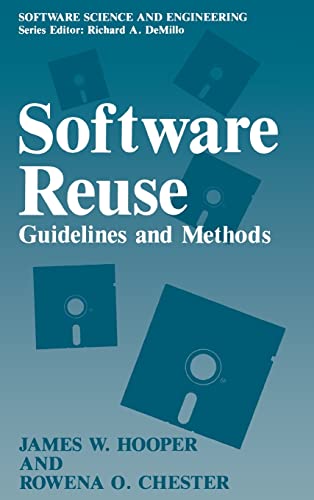


Software Reuse: Guidelines and Methods (Software Science and Engineering)
| SELLER | SELLER SCORE | AMAZON FULFILLED | PRIME | FREE SHIPPING |
|---|---|---|---|---|
| Amazon.com | 9.68 | Yes | Yes | Yes |
A lead architect sits hunched over a complex codebase, realizing that the entire project's success hinges on how effectively they can leverage existing components rather than reinventing the wheel. Software Reuse: Guidelines and Methods serves as a rigorous roadmap for this exact high-stakes moment. Part of the Software Science and Engineering series, this text moves beyond surface-level advice to provide deep, methodological frameworks for implementing reuse in professional environments. While the price point reflects its specialized academic and professional nature, the depth of insight offered by Plenum Publishing Corporation makes it a foundational resource for anyone serious about engineering efficiency. It is less of a casual read and more of a technical manual for scaling software development through disciplined reuse strategies.

Mastering Scale and Complexity in Software Reuse: 16th International Conference on Software Reuse, ICSR 2017, Salvador, Brazil, May 29-31, 2017, Proce...
| SELLER | SELLER SCORE | AMAZON FULFILLED | PRIME | FREE SHIPPING |
|---|---|---|---|---|
| Amazon.com Services LLC | 0.00 | No | No | No |
Software architects and academic researchers demanding cutting-edge insights into modularity must treat this collection as an essential technical resource. This volume, stemming from the 16th International Conference on Software Reuse, captures a pivotal moment in the evolution of complex system design. Rather than offering surface-level tutorials, it dives deep into the academic rigor required to manage large-scale software ecosystems. Since it is available for immediate digital download, you can bypass the wait for physical shipping and start integrating these high-level methodologies into your research or development workflows right away. It is a dense, specialized deep dive that serves as a cornerstone for anyone serious about the mechanics of scalable software reuse.

When browsing software reuse literature, your first decision factor should be the level of abstraction the book addresses. Software reuse operates on several tiers: code-level reuse (functions and classes), component-level reuse (independent modules), and architectural-level reuse (entire system patterns). If you are a junior developer looking to write cleaner, more modular code, look for books focusing on Design Patterns and SOLID principles. If you are a systems architect, you should prioritize texts that discuss Microservices, Service-Oriented Architecture (SOA), and Domain-Driven Design (DDD), as these frameworks provide the structural blueprint for high-level reuse.
A common pitfall in technical reading is purchasing a book that is purely academic when you require practical application. Some books focus heavily on the mathematical proofs of software modularity and the formal verification of components. While these are invaluable for high-integrity systems (such as aerospace or medical software), they may offer little value for a web developer looking to optimize a CI/CD pipeline. Look for books that include case studies, code examples, and 'lessons learned' sections. A high-quality guide will not just tell you *that* reuse is beneficial, but will show you *how* to manage the technical debt and versioning challenges that inevitably arise when multiple teams rely on the same shared components.
True mastery of software reuse requires understanding the entire lifecycle, not just the moment of integration. Effective books will cover the 'Reuse Paradox'—the idea that creating reusable components often requires more upfront effort than writing bespoke code. When evaluating a title, check if it addresses:
Finally, decide whether you need language-agnostic principles or language-specific implementation guides. General software engineering principles (like those found in classic texts on object-oriented design) are timeless and apply whether you are working in C++, Java, or Python. However, if you are working in a highly specialized environment like functional programming or cloud-native serverless architectures, you may find more value in books that address the unique reuse patterns of those specific paradigms, such as higher-order functions or infrastructure-as-code modules.
Quick answers about Software Reuse Books before you buy.
Share of top-ranked products by brand, from our editorial analysis.
We've carried out a comprehensive analysis of 2,344 reviews on Software Reuse Books, using our selection criteria to identify the best options in the computers & technology. Our findings reveal that most customers typically select Software Reuse Books priced around $67.44, with top brands including springer, plenum publishing corporation, wiley and acm books and erich gamma.
Our team of expert editors reviewed these high-quality items and handpicked the top 16 Software Reuse Books for your consideration. We've also done extensive research on numerous sellers, identifying the best ones in the computers & technology category — including books unplugged, amazon.com services llc, thriftbooks-baltimore, amazon.com, sprinkle books, super book sales and thbooks4you and books_express_usa.
We are dedicated to assisting our users in finding the right technology Products based on their needs, saving them considerable time when choosing which Software Reuse Books to buy. We take pride in the number of satisfied users we've helped through our thorough and insightful reviews.
Compare the top 16 picks at a glance — select a column to sort.