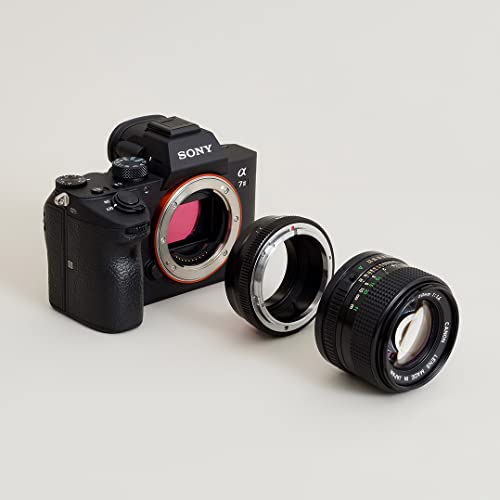
Understanding Mount Compatibility
The most critical factor in selecting a converter is the specific marriage of your lens mount and your camera body mount. Lens adapters are not universal. They are precision-engineered for specific combinations. You must identify your lens's native mount (such as M42, Nikon F, or Canon EF) and your camera's mount (such as Sony E, Fujifilm X, or Micro Four Thirds). When browsing converters, ensure the direction of adaptation is correct. You can adapt an older lens to a newer body, but you cannot adapt a newer lens to an older body. Always double-check the flange distance requirements of your camera system to ensure the converter provides enough physical clearance for the lens to reach infinity focus.
Mechanical Precision and Build Quality
A converter is a mechanical bridge, and any play or wobble in that bridge will manifest as soft images or vignetting. When evaluating converters, look for those constructed from high-grade metals rather than plastics. Metal construction ensures that the mounting ring maintains its shape under the weight of heavier lenses and provides a more secure lock to the camera body. High-quality converters should feature tight tolerances. When you twist the lens into the adapter, there should be no perceptible lateral movement. This stability is essential for maintaining the optical axis, ensuring that light hits the sensor straight on rather than at an angle.
Electronic Communication vs. Manual Control
One of the most important decision points is whether you require electronic communication. Most vintage lens converters are 'dumb' adapters, meaning they lack electrical pins. This is perfectly fine for manual focus lenses, but it means your camera will not be able to control aperture, autofocus, or EXIF data (such as focal length and aperture settings). If you are adapting modern lenses to a different system, you may want to look for 'smart' converters that include electronic contacts to maintain autofocus and aperture control. However, for enthusiasts using classic glass, a high-quality manual converter is often preferred for its simplicity and reliability.
Aperture Control and Light Integrity
When using a manual converter on a camera body that cannot electronically control the lens aperture, you must ensure the lens itself has a physical aperture ring. If you are adapting a lens that relies on electronic aperture control to a manual adapter, you may find yourself stuck at the widest aperture setting. Additionally, look for converters that feature internal baffling or matte finishes to prevent internal reflections. Light leaks can ruin a shot, especially when shooting in high-contrast environments, so a well-sealed converter is paramount for maintaining professional image quality.
Recommendation Logic
If you are a street photographer using lightweight prime lenses, prioritize compact, slim-profile converters that don't add excessive bulk to your setup. For landscape or studio photographers using heavy telephoto or macro glass, prioritize heavy-duty, reinforced metal adapters that can support the weight without sagging. If your goal is purely aesthetic—using vintage glass for its unique bokeh and color rendering—a simple, high-quality manual adapter is your best value. Only invest in more complex, electronically communicating converters if your workflow requires seamless autofocus and metadata integration.