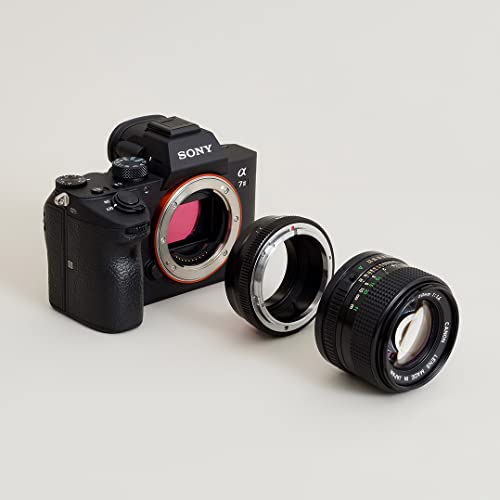
Understanding Mount Compatibility and Flange Distance
The most critical factor in selecting an adapter is the mathematical relationship between your lens mount and your camera mount. You cannot simply look at the brand names. You must understand the physical interface. The 'flange focal distance'—the space between the lens mount and the sensor—is the primary constraint. When choosing an Urth adapter, ensure it is specifically designed for your camera's mount (such as Sony E-mount, Fujifilm X-mount, or Canon RF) and the specific vintage mount of your lens (such as M42, Nikon F, or Pentax K). A mismatch in flange distance will result in an adapter that is either too thick, preventing the lens from reaching infinity focus, or too thin, causing the lens to strike the camera body. Always verify that the adapter's intended application matches your specific lens-to-body combination to avoid permanent hardware damage.
Build Quality and Material Integrity
Cheaply made adapters are often constructed from thin aluminum or even plastic, which can flex under the weight of professional lenses. This flex leads to 'sensor tilt,' where the lens is no longer perfectly parallel to the sensor, causing one side of your image to be sharp while the other is blurry. Urth adapters are distinguished by their robust construction, typically utilizing high-quality metal alloys. When deciding, consider the weight of your glass. If you are using heavy, vintage prime lenses, prioritize an adapter with a heavy-duty locking mechanism. A high-quality converter should feel like a seamless extension of the camera body, providing a tactile, secure click when engaged to prevent the lens from rotating unexpectedly during a shoot.
Aperture Control and Electronic Communication
One of the biggest hurdles in lens adaptation is the loss of control. Most vintage lenses are fully manual, meaning they lack the electronic pins required to communicate with modern mirrorless cameras. When shopping for a converter, you must decide if you are comfortable with a fully manual workflow. Some adapters are designed to be 'dumb' adapters, which are simple mechanical bridges that allow you to control aperture via the lens ring itself. Others may attempt to bridge certain electronic gaps, though this is rare for vintage glass. If you are adapting modern lenses that require electronic communication for autofocus or iris control, you must ensure the adapter supports those specific data protocols. For most Urth users working with legacy optics, the focus should be on mechanical precision and ensuring the aperture ring on the lens remains fully functional.
Optical Precision and Light Sealing
A common failure in low-end converters is the presence of internal light leaks. If the adapter does not fit perfectly flush against the camera mount, stray light can enter the sensor chamber, creating flare or reducing contrast. Look for adapters that feature precision-machined mating surfaces. Additionally, consider the internal diameter of the adapter. A well-designed converter will have an internal bore that is wide enough to prevent vignetting—the dark corners often seen when an adapter's internal walls clip the light path of a wide-angle lens. Urth's commitment to precision helps mitigate these issues, but as a buyer, you should always cross-reference your lens's field of view with the adapter's design specifications to ensure maximum light throughput.