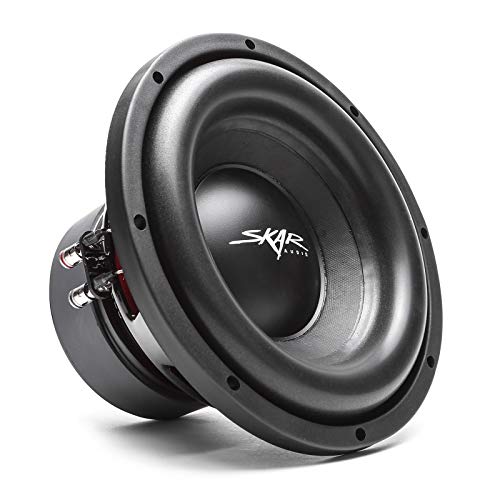
Understanding Power Handling and RMS vs. Peak
The most common mistake enthusiasts make is looking at 'Peak Power' or 'Max Power' ratings. In the world of high-performance audio, these numbers are largely marketing fluff. To get the most out of a SKAR subwoofer, you must focus on the RMS (Root Mean Square) rating. RMS represents the continuous power the subwoofer can handle reliably over time without overheating or mechanical failure. When planning your build, ensure your amplifier's RMS output matches or slightly exceeds the subwoofer's RMS rating. If you buy a subwoofer rated for 1,000W RMS but pair it with a 500W RMS amplifier, you will struggle to achieve the desired output. Conversely, if your amp is significantly overpowered, you risk blowing the voice coil through clipping or excessive excursion.
Single vs. Dual Voice Coil (SVC vs. DVC)
Subwoofers generally come in two configurations: Single Voice Coil (SVC) and Dual Voice Coil (DVC). This decision is critical because it dictates how you wire your system to your amplifier. A single voice coil subwoofer has one set of terminals, making it straightforward to wire. A dual voice coil subwoofer has two separate sets of windings. DVC subwoofers offer much more flexibility for impedance matching. For example, if you have two 4-ohm DVC subwoofers, you can wire them in parallel to create a 1-ohm load, which allows your amplifier to output its maximum potential power. If you are an entry-level builder, SVC is simpler, but if you are looking to maximize efficiency and power, DVC is the professional standard.
Enclosure Type: Sealed vs. Ported
The box your subwoofer lives in is just as important as the driver itself. A sealed enclosure is compact and provides tight, accurate, and 'musical' bass. This is ideal if you listen to a variety of genres, including rock or jazz, where precision is key. However, if your goal is pure, earth-shaking SPL (Sound Pressure Level), you need a ported (vented) enclosure. Ported boxes use a tuned opening to reinforce low-frequency waves, resulting in significantly higher output. The trade-off is that ported boxes are physically larger and the bass may feel slightly less 'controlled' than a sealed setup. When selecting a SKAR driver, consider whether you want surgical precision or overwhelming volume.
Impedance Matching for Maximum Efficiency
Impedance, measured in Ohms, is the electrical resistance the subwoofer presents to your amplifier. Most car audio amplifiers are most efficient at 1-ohm or 2-ohm loads. When selecting your subwoofers, you must calculate the final impedance of your wiring configuration. If your amplifier is stable only down to 2 ohms, and you wire two 4-ohm subwoofers in parallel, you will hit that 2-ohm sweet spot perfectly. If you miscalculate and drop to 1 ohm on a 2-ohm stable amp, you risk thermal shutdown or permanent hardware damage. Always map out your wiring diagram before purchasing your components to ensure compatibility.
Physical Dimensions and Installation Space
Finally, never overlook the physical footprint. High-output subwoofers often feature massive magnets and deep mounting depths to accommodate long-throw voice coils. Before committing to a heavy-duty model, measure your trunk space or custom enclosure depth. A subwoofer that is too deep for your enclosure will result in the magnet hitting the back of the box, causing catastrophic failure. Account for the displacement of the box itself—the air moved by the cone and the volume occupied by the magnet will change the internal tuning of your enclosure.