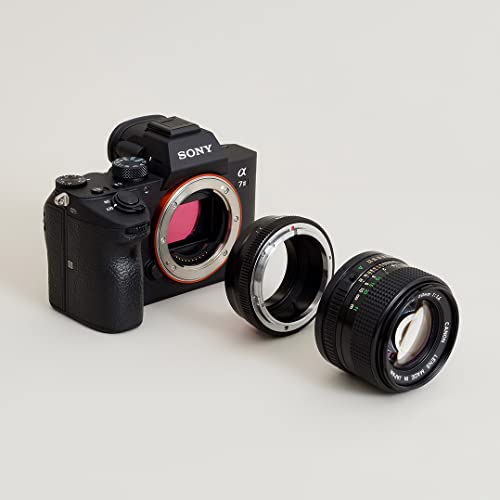
Understanding Mount Compatibility and Precision Fit
The most fundamental aspect of selecting a converter is ensuring absolute mechanical compatibility. You aren't just looking for a way to make two pieces of glass touch. You are looking for a tool that maintains the flange focal distance. If the converter is even a fraction of a millimeter too thick, you will lose the ability to focus at infinity, rendering your lenses useless for landscapes or street photography. When browsing the Urth lineup, always verify the specific lens mount (e.g., EF, E-mount, MFT, or L-mount) and the camera body mount. A high-quality converter should click into place with a tactile, secure sensation, ensuring that the lens does not wobble or shift during heavy use or when mounted on a gimbal.
Prioritizing Optical Clarity and Coatings
A common mistake among beginners is treating a converter as a mere mechanical piece of metal. In reality, many advanced converters incorporate optical elements to correct for light loss or focal length changes. When evaluating options, look for converters that utilize high-grade glass and specialized anti-reflective coatings. These coatings are critical for minimizing flare and ghosting, especially when shooting toward bright light sources or during golden hour. A cheap, poorly coated converter can introduce unwanted artifacts that are impossible to remove in post-processing. Urth converters are specifically designed to maintain the light transmission properties of your original glass, so prioritize models that emphasize optical transparency and minimal light degradation.
Electronic Communication vs. Manual Control
One of the most significant decision factors is whether you require electronic communication between the lens and the camera body. Manual converters are excellent for vintage lenses that lack electronic pins. They are robust, simple, and highly reliable. However, if you are adapting modern lenses, you may want a converter that supports autofocus, aperture control, and EXIF data transmission. Electronic converters act as a digital bridge, allowing your camera to 'talk' to the lens. If you are a studio photographer using fixed primes, a manual converter is often more than sufficient. If you are a wedding or event photographer who relies on rapid autofocus, investing in a converter with electronic contacts is non-negotiable.
Build Quality and Durability for Field Use
Converters are often subjected to temperature shifts, dust, and physical handling in the field. Avoid converters made from lightweight plastics or thin alloys that might bend under the weight of heavy telephoto lenses. Instead, look for heavy-duty metal construction—typically brass or high-grade aluminum. A sturdy build prevents the 'lens sag' that can occur when a heavy lens is mounted on a small mirrorless body. Furthermore, check for weather-sealing capabilities or robust dust-protection designs. A well-constructed converter should feel like an extension of the lens itself, providing a seamless and durable connection that can withstand the rigors of professional travel and outdoor shooting environments.