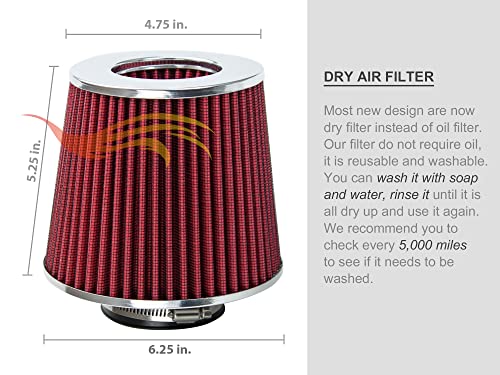
Understanding Airflow vs. Filtration Efficiency
The most critical concept in performance filtration is the balance between CFM (Cubic Feet per Minute) and micron rating. A filter that offers massive airflow but allows large dust particles to pass through will act like sandpaper on your piston rings over time. Conversely, a filter with an extremely high micron rating may protect the engine perfectly but will create a pressure drop that chokes your intake during high RPM stretches. When selecting a racing filter, look for products that utilize advanced media—such as multi-layered cotton gauze or specialized synthetic blends—that provide a high surface area. A larger surface area allows for more air to pass through at lower velocities, which maintains filtration integrity without creating a vacuum effect that starves the engine.
Material Composition: Cotton vs. Synthetic
Decision-making often comes down to the media type. Cotton gauze filters are a staple in the racing world because they are highly predictable and can be oiled to specific levels to tune the filtration density. By adjusting the amount of specialized oil applied to the media, you can effectively 'dial in' the balance between flow and protection. Synthetic filters, on the other hand, often use non-woven fibers that are engineered to trap particles through electrostatic charge rather than just physical blocking. Synthetic options are frequently more 'set it and forget it,' offering consistent performance without the need for manual oiling, but they may lack the fine-tuning capabilities that professional tuners prefer when chasing specific power bands.
Enclosure and Seal Integrity
A high-flow filter is useless if the air takes the path of least resistance around the edges. In racing applications, 'unmetered air' or 'vacuum leaks' can cause erratic idling, lean fuel mixtures, and unpredictable power delivery. When evaluating a performance filter, inspect the housing and the sealing mechanism. Look for high-quality polyurethane or reinforced rubber gaskets that create a vacuum-tight seal against the intake housing. If you are upgrading an existing intake system, ensure the filter's flange or mounting style is perfectly compatible with your current velocity stacks or airbox to prevent bypass leakage.
Maintenance and Longevity in Racing Conditions
Racing environments are significantly harsher than daily commuting. Track days involve high concentrations of tire rubber dust, brake dust, and varying levels of ambient debris. Therefore, your choice should be dictated by your maintenance schedule. Washable, reusable filters are the industry standard for a reason. They allow you to clean the media and re-oil it after every session. However, you must consider the cost and complexity of the cleaning kits. If you are racing in extremely dusty or sandy environments, you will need a filter that can be serviced frequently without the media degrading or the structural integrity of the pleats collapsing under high suction.
Final Recommendation Logic
To make the best choice, first define your primary goal: Are you seeking a broad increase in mid-range torque for street driving, or are you looking for peak horsepower at the top of the RPM range for competitive racing? For peak power, prioritize the highest CFM rating and a filter with a large surface area. For a balanced daily driver that sees occasional track use, prioritize a high-quality cotton gauze filter that allows you to adjust the oil levels to suit your local air quality. Always prioritize the quality of the seal over the raw airflow numbers. A slightly less efficient filter that seals perfectly will always outperform a high-flow filter that leaks.