Understanding Drive Sizes and Compatibility
The most critical decision when purchasing square drive sockets is selecting the correct drive size. The 'square drive' refers to the internal opening of the socket where your ratchet, breaker bar, or torque wrench attaches. Common sizes include 1/4-inch for precision work in tight spaces, 3/8-inch for general automotive and household repairs, and 1/2-inch for heavy-duty applications requiring significant leverage. While it is tempting to buy a mismatched set, consistency is key for efficiency. If your primary ratchet is a 1/2-inch drive, investing in a comprehensive 1/2-inch socket set will provide the necessary torque capacity for larger fasteners, whereas 1/4-inch sockets are better suited for delicate electronics or small engine components where over-tightening could cause damage.
Impact vs. Chrome: Material and Application
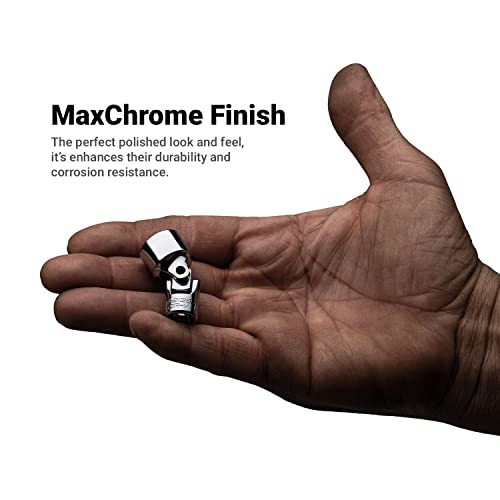
A common mistake is using standard chrome-plated sockets with impact wrenches. Chrome sockets are designed for hand tools. They are hard and brittle, which makes them excellent for preventing rounding of the fastener, but they can shatter under the violent, rapid-fire vibrations of an impact driver. If you plan to use power tools, you must look specifically for impact-rated sockets. These are typically made from a more ductile alloy steel, often finished in a matte black phosphate coating, which allows the socket to absorb shock without cracking. Conversely, if your work is strictly manual, chrome-finished sockets are superior because they offer higher surface hardness and better corrosion resistance, making them easier to clean and more pleasant to handle in a workshop setting.
Socket Profile: 6-Point vs. 12-Point
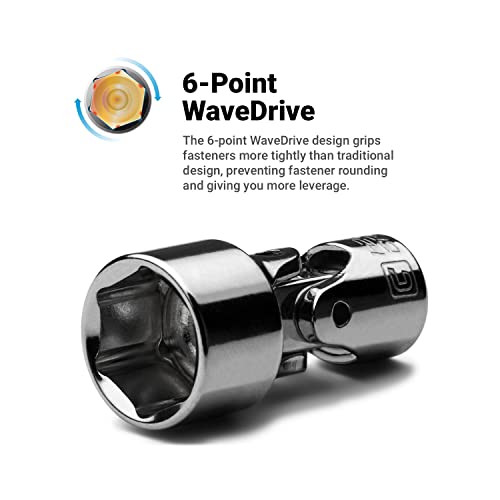
The geometry of the socket's internal teeth is a major factor in how well it grips a fastener. A 6-point socket provides six flat contact points, which is the gold standard for high-torque applications. Because it grips the flat sides of a hexagonal bolt rather than the corners, it is much less likely to 'round off' a stubborn or rusted fastener. A 12-point socket, on the other hand, offers more versatility in tight spaces where you cannot swing a ratchet through a full arc, as it can be engaged at more angles. However, for heavy-duty mechanical work, the 6-point design is almost always the safer and more durable choice to prevent tool slippage and fastener damage.
Set Composition and Organization
When buying Capri Tools sockets, consider whether you need a complete master set or specific individual sizes. A comprehensive set provides a logical progression of sizes, ensuring you aren't caught off guard by a metric or SAE fastener you didn't account for. Look for sets that include a specialized storage case—such as a heavy-duty plastic organizer or a socket rail—which prevents tools from rolling around in your toolbox. A well-organized set not only saves time but also allows you to quickly identify if a tool is missing before you leave a job site. For professionals, a set that mixes both metric and imperial sizes in a single organized system is often the most efficient investment for versatile repair environments.