#TOP1

In the field of structural integrity and mechanical design, the selection of testing equipment and analytical tools is not merely a matter of convenience. It is a matter of safety and precision. Strength of materials engineering requires hardware that can accurately quantify how solids behave under various loading conditions, including tension, compression, torsion, and shear. Whether you are a researcher studying fatigue life or a quality control engineer verifying the yield strength of a new alloy, the reliability of your data depends entirely on the calibration, sensitivity, and durability of your instrumentation.
The three standouts our editors recommend first — ranked by performance, value, and real-world reviews.


| SELLER | SELLER SCORE | AMAZON FULFILLED | PRIME | FREE SHIPPING |
|---|---|---|---|---|
| Apex_media🍏 | 9.87 | Yes | Yes | Yes |

Applied Statics and Strength of Materials
| SELLER | SELLER SCORE | AMAZON FULFILLED | PRIME | FREE SHIPPING |
|---|---|---|---|---|
| Amazon.com | 9.68 | Yes | Yes | Yes |
Engineering students often assume that the most expensive textbooks are the ones that provide the most value, but the real worth of a text like Applied Statics and Strength of Materials lies in its structural clarity. Pearson has developed a resource that tackles the complex intersection of force equilibrium and material deformation without unnecessary fluff. While the price tag might feel steep for a single semester, the depth of content provided makes it a foundational pillar for anyone serious about mechanical or civil engineering. It is a heavy-duty academic tool designed to bridge the gap between theoretical physics and real-world structural application, ensuring you aren't just memorizing formulas but actually understanding how loads interact with physical components.

Statics and Strength of Materials
| SELLER | SELLER SCORE | AMAZON FULFILLED | PRIME | FREE SHIPPING |
|---|---|---|---|---|
| Nesta Trading | 8.19 | Yes | Yes | Yes |
The weight of this heavy volume in your hands immediately signals its role as a foundational pillar for any engineering student. Statics and Strength of Materials serves as a rigorous deep dive into the mechanical principles that govern how structures hold up under pressure. While the price point represents a significant upfront investment for a student, the depth of technical content is essential for mastering complex load calculations and material behaviors. It is a dense, serious resource designed for those who need to move beyond theory and into the practical physics of structural integrity. If you are preparing for a career in civil or mechanical engineering, having this specific text on your desk is a non-negotiable part of the journey.


History of Strength of Materials (Dover Civil and Mechanical Engineering)
| SELLER | SELLER SCORE | AMAZON FULFILLED | PRIME | FREE SHIPPING |
|---|---|---|---|---|
| Amazon.com | 9.68 | Yes | Yes | Yes |
A late-night study session in a quiet engineering lab often requires more than just modern formulas. It demands a deep understanding of how these principles evolved. This Dover Publications volume serves as that essential bridge, tracing the intellectual lineage of mechanical and civil engineering through a historical lens. Instead of just presenting dry equations, it contextualizes the development of material science, making it a standout resource for students and professionals alike who want to understand the 'why' behind the math. At an incredibly accessible price point, it transforms a complex academic subject into a readable narrative of human ingenuity. It is the kind of foundational text that belongs on a reference shelf for anyone serious about the mechanics of the physical world.


Statics and Strength of Materials
| SELLER | SELLER SCORE | AMAZON FULFILLED | PRIME | FREE SHIPPING |
|---|---|---|---|---|
| ThriftBooks-Baltimore | 9.89 | No | No | No |
Engineering students facing the brutal learning curve of structural mechanics need this McGraw-Hill Education textbook as their primary survival guide. Mastering the fundamental principles of how forces interact with stationary bodies and how materials deform under stress requires a resource that prioritizes clarity over dense, unapproachable jargon. This text serves as a foundational pillar for anyone serious about civil or mechanical engineering disciplines. While the technical depth is substantial, the content is structured to build a logical progression from basic equilibrium to complex material behaviors. It represents a necessary investment for a semester of rigorous study, providing the essential theoretical framework required to pass high-stakes exams and understand real-world structural integrity.


Strength of Materials (Dover Books on Physics)
| SELLER | SELLER SCORE | AMAZON FULFILLED | PRIME | FREE SHIPPING |
|---|---|---|---|---|
| Amazon.com | 9.68 | Yes | Yes | Yes |
Engineering students often struggle to find foundational texts that balance rigorous mathematical theory with practical application without breaking the bank. This Dover Publications edition serves as a vital bridge for anyone needing to master the mechanics of deformable bodies. It tackles the complex physics of how materials respond to external forces, making it an essential cornerstone for a technical library. While the subject matter is inherently dense, the clarity of the Dover physics series helps demystify structural behavior and stress analysis. At its current price point, it is an incredibly accessible way to own a classic reference that remains relevant for both academic study and professional engineering practice.

Applied Statics and Strength of Materials (5th Edition)
| SELLER | SELLER SCORE | AMAZON FULFILLED | PRIME | FREE SHIPPING |
|---|---|---|---|---|
| Toyarcade | 9.77 | Yes | Yes | Yes |
Engineering students tackling complex structural mechanics require a textbook that bridges the gap between abstract theory and real-world application. This fifth edition from Pearson serves as a vital roadmap for mastering the fundamental principles of statics and material behavior. Rather than just presenting formulas, the text focuses on the practical physics necessary to understand how forces interact within physical structures. It is a heavy-duty academic resource designed to support rigorous coursework and long-term professional comprehension. While the price point reflects its specialized technical depth, the clarity of the instructional approach makes it a cornerstone for anyone serious about a career in mechanical or civil engineering.

| SELLER | SELLER SCORE | AMAZON FULFILLED | PRIME | FREE SHIPPING |
|---|---|---|---|---|
| Tome Dealers | 9.62 | Yes | Yes | Yes |
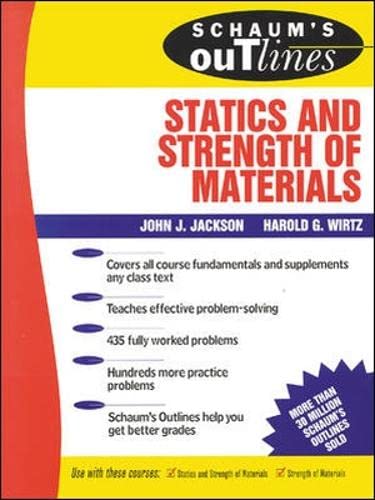


Schaum's Outline of Statics and Strength of Materials (Schaum's Outline Series)
| SELLER | SELLER SCORE | AMAZON FULFILLED | PRIME | FREE SHIPPING |
|---|---|---|---|---|
| ASELStore | 9.92 | Yes | Yes | Yes |
Late-night study sessions in the engineering library often turn into frantic battles with complex force diagrams and stress analysis equations. This Schaum's Outline serves as a vital lifeline during those exact moments when a textbook explanation feels too abstract to be useful. Instead of wading through dense, theoretical fluff, you get straight to the mechanics of how materials behave under load. It functions less like a traditional lecture and more like a practical toolkit for solving problems. Whether you are prepping for a midterm or trying to untangle a tricky structural calculation, the focused approach helps bridge the gap between theory and application. It is a reliable companion for anyone needing to master the fundamentals of statics without getting lost in unnecessary academic jargon.

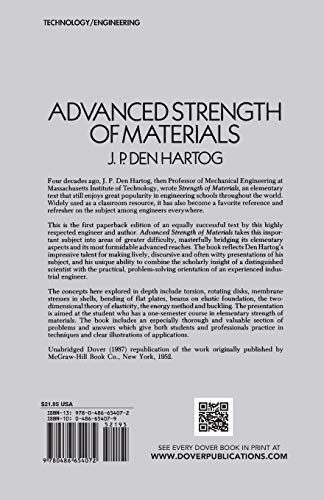

Advanced Strength of Materials (Dover Civil and Mechanical Engineering)
| SELLER | SELLER SCORE | AMAZON FULFILLED | PRIME | FREE SHIPPING |
|---|---|---|---|---|
| Amazon.com | 9.68 | Yes | Yes | Yes |
After weeks of deep diving into complex structural calculations, I finally realized why this Dover edition remains a staple for serious engineers. This text doesn't just skim the surface. It dives straight into the heavy lifting required for civil and mechanical disciplines. It feels like an absolute steal for the depth of technical knowledge you are getting. I found that the clarity of the material makes even the most daunting mathematical proofs feel approachable. It is a reliable, no-nonsense resource that belongs on the desk of any student or professional looking to master the fundamental physics of how materials behave under stress.

| SELLER | SELLER SCORE | AMAZON FULFILLED | PRIME | FREE SHIPPING |
|---|---|---|---|---|
| Amazon.com Services LLC | 0.00 | No | No | No |

Applied Strength of Materials
| SELLER | SELLER SCORE | AMAZON FULFILLED | PRIME | FREE SHIPPING |
|---|---|---|---|---|
| itemspopularsonlineaindemand | 9.84 | Yes | Yes | Yes |
Applied Strength of Materials stands as a cornerstone academic resource for anyone diving deep into structural engineering and mechanical analysis. While many textbooks in this niche can feel prohibitively expensive or overly dense, this volume offers a practical approach to understanding how materials behave under stress. It represents a solid investment for students or professionals who need a reliable reference on hand. It is currently in stock and ready for immediate use in a rigorous study environment. Navigating the complexities of load, tension, and shear becomes much more manageable when you have a dedicated text that focuses on the applied aspects of the discipline rather than just abstract theory.

| SELLER | SELLER SCORE | AMAZON FULFILLED | PRIME | FREE SHIPPING |
|---|---|---|---|---|
| Hamelyn | 9.29 | No | No | No |

Strength of Materials: Fundamentals and Applications
| SELLER | SELLER SCORE | AMAZON FULFILLED | PRIME | FREE SHIPPING |
|---|---|---|---|---|
| Amazon.com | 9.68 | Yes | Yes | Yes |
Cambridge University Press has established a definitive standard for engineering students and professionals requiring a deep dive into structural mechanics. This text, Strength of Materials: Fundamentals and Applications, serves as a rigorous cornerstone for anyone serious about understanding how physical bodies respond to external loads. Rather than just providing dry formulas, the material bridges the gap between theoretical physics and practical, real-world engineering applications. It is an essential investment for those building a career in civil or mechanical engineering, offering the foundational clarity needed to tackle complex structural challenges. At its current price point, it stands as a high-value academic asset that remains readily available for immediate study.


| SELLER | SELLER SCORE | AMAZON FULFILLED | PRIME | FREE SHIPPING |
|---|---|---|---|---|
| Amazon.com | 9.68 | Yes | Yes | Yes |

| SELLER | SELLER SCORE | AMAZON FULFILLED | PRIME | FREE SHIPPING |
|---|---|---|---|---|
| RockCityBooks | 9.54 | Yes | Yes | Yes |


| SELLER | SELLER SCORE | AMAZON FULFILLED | PRIME | FREE SHIPPING |
|---|---|---|---|---|
| Amazon.com | 9.68 | Yes | Yes | Yes |


| SELLER | SELLER SCORE | AMAZON FULFILLED | PRIME | FREE SHIPPING |
|---|---|---|---|---|
| Amazon.com | 9.68 | Yes | Yes | Yes |



Polymer Characterization: Physical Techniques, 2nd Edition
| SELLER | SELLER SCORE | AMAZON FULFILLED | PRIME | FREE SHIPPING |
|---|---|---|---|---|
| Amazon.com | 9.68 | Yes | Yes | Yes |
Polymer Characterization: Physical Techniques, 2nd Edition is an essential technical cornerstone for anyone serious about material science. This CRC Press publication provides a deep dive into the methodologies required to understand polymer properties at a professional level. Since this is a used copy in good condition, you are getting a high-level academic resource without the typical premium price tag of a brand-new textbook. It serves as a reliable reference for laboratory work and theoretical study alike. Whether you are navigating complex physical measurements or refining your analytical skills, this edition delivers the technical depth needed for accurate characterization in a research or industrial setting.

The first decision in selecting engineering tools is determining the nature of the stress you intend to measure. Static testing equipment is designed for slow, controlled applications of force to determine properties like Young’s Modulus or ultimate tensile strength. However, if your work involves vibration, impact, or cyclical loading, you must prioritize dynamic testing apparatus. For dynamic environments, look for high-frequency sampling rates and sensors capable of capturing rapid transient responses without signal attenuation. Choosing a static machine for a dynamic application will result in significant data lag and inaccurate stress-strain curves.
In strength of materials, the margin for error is often microscopic. When evaluating load cells or extensometers, do not look solely at the maximum capacity. Focus on the resolution. A high-capacity load cell that lacks the sensitivity to detect small fluctuations in the elastic region of a material will render your modulus calculations useless. For precision work, seek out equipment that offers high linearity and minimal hysteresis. Hysteresis—the difference in readings when a load is applied versus when it is removed—can lead to catastrophic errors in calculating energy absorption and toughness.
A common failure point in material testing is not the material itself, but the interface between the specimen and the machine. If you are testing ductile metals, your grips must provide sufficient clamping force to prevent slippage without inducing premature failure at the grip interface. For brittle ceramics or composites, you require specialized hydraulic or pneumatic grips that distribute pressure evenly to avoid crushing the specimen. Always consider the geometry of the testing area: if you are performing torsion tests, ensure the torque transducers are calibrated for the specific rotational stiffness of your intended materials.
Modern engineering requires more than just a physical reading. It requires a digital audit trail. Look for systems that offer seamless integration between the hardware and sophisticated data acquisition software. The ability to export raw data for Finite Element Analysis (FEA) or to integrate real-time strain gauge feedback into a closed-loop control system is vital for advanced R&D. Ensure the software allows for custom curve fitting and automated calculation of stress-strain parameters to reduce human error during post-test analysis.
Finally, ensure that any equipment you purchase meets international standards such as ASTM or ISO. In a professional engineering environment, uncalibrated equipment is a liability. Prioritize tools that come with traceable calibration certificates and easy-to-follow maintenance protocols. The long-term value of your investment is tied to how easily the device can be re-certified to maintain its accuracy over years of rigorous use.
Quick answers about Strength Of Materials Engineering before you buy.
Share of top-ranked products by brand, from our editorial analysis.
We've carried out a comprehensive analysis of 73 reviews on Strength Of Materials Engineering, using our selection criteria to identify the best options in the arts & crafts. Our findings reveal that most customers typically select Strength Of Materials Engineering priced around $144.49, with top brands including elsevier, academic press, dover publications, pearson, cambridge university press and mcgraw-hill education and crc press.
Our team of expert editors reviewed these high-quality items and handpicked the top 19 Strength Of Materials Engineering for your consideration. We've also done extensive research on numerous sellers, identifying the best ones in the arts & crafts category — including amazon.com, rockcitybooks, amazon.com services llc, nesta trading, itemspopularsonlineaindemand, aselstore, thriftbooks-baltimore, apex_media🍏 and tome dealers and toyarcade.
We are dedicated to assisting our users in finding the right asins Products based on their needs, saving them considerable time when choosing which Strength Of Materials Engineering to buy. We take pride in the number of satisfied users we've helped through our thorough and insightful reviews.
Compare the top 19 picks at a glance — select a column to sort.


