Baby Stroller Buying Guide: Safety, Fold & Fit
Quick Answer: TL;DR Before You Shop
- Match type to lifestyle first: lightweight/umbrella for city walking and stairs, full-size travel system for car-based errands, jogging stroller only if you're actually running 3+ miles/week.
- Safety floor to verify: every stroller sold in the US must meet the federal standard 16 CFR 1227, which incorporates ASTM F833. Look for a JPMA-certified sticker as an added (voluntary) layer of testing beyond the federal minimum.
- Fold benchmark: if it takes more than about 10 seconds or requires two hands while you're holding a child, expect to skip folding it most days. Test this in-store before buying.
- Weight capacity rule: check the specific stroller's rated weight and age range in the manual, not just the marketing copy. Infant recline/head-support needs and toddler weight limits vary by model.
- Typical budget bands: umbrella/lightweight $50–$150, full-size travel systems $200–$600, jogging strollers $250–$700, double/tandem $300–$900.
Sizing up a stroller the wrong way is the top driver of "why don't we use this anymore" regret, not a defect in the product, but a mismatch between the stroller and how a family actually moves through a day. This guide leads with that matching logic before any product talk, then covers the safety, fold, and real-world details most buying guides skip.
A note on the figures in this guide: Price bands, fold-time benchmarks, and weight-related guidance below reflect ranges commonly seen across major stroller brands and industry/regulatory sources (CPSC, ASTM, JPMA), not a single lab test of one product. Always confirm the exact weight limit, age range, and safety labeling on the specific stroller you're considering.
What Type of Stroller Fits Your Lifestyle First
Before comparing features, match the stroller category to how you actually move through a week. Most buyer's remorse traces back to skipping this step and buying on looks or brand recognition instead.
|
Stroller Type |
Best For |
Avg Weight |
Avg Price Range |
Fold Difficulty |
|
Lightweight / umbrella |
City walking, stairs, small apartments, air travel |
10–16 lbs |
$50–$150 |
Easy, often one-handed |
|
Full-size/travel system |
Car-based errands, click-in infant car seat use |
20–30 lbs |
$200–$600 |
Moderate, usually two-handed |
|
Jogging stroller |
Running or fast walking on pavement/trails, 3+ miles/week |
25–33 lbs |
$250–$700 |
Harder, often bulkier folded |
|
Double / tandem |
Two children close in age, or newborn + toddler |
30–40 lbs |
$300–$900 |
Hardest, largest folded footprint |
Scenario anchors:
- An urban apartment dweller taking stairs daily generally does best with a sub-15 lb umbrella stroller. A 28 lb full-size stroller becomes a genuine daily obstacle on stairs, not a minor inconvenience.
- An SUV owner making weekly road trips or errands benefits most from a full-size travel system with car-seat click-in, trading portability for one-motion transfers between car and stroller.
- A parent training for a postpartum 10K needs a jogging stroller with a fixed or lockable front wheel and a hand brake. A standard swivel-wheel stroller becomes genuinely unstable at running speed.
Full-Size Strollers vs. Travel Systems vs. Lightweight Strollers
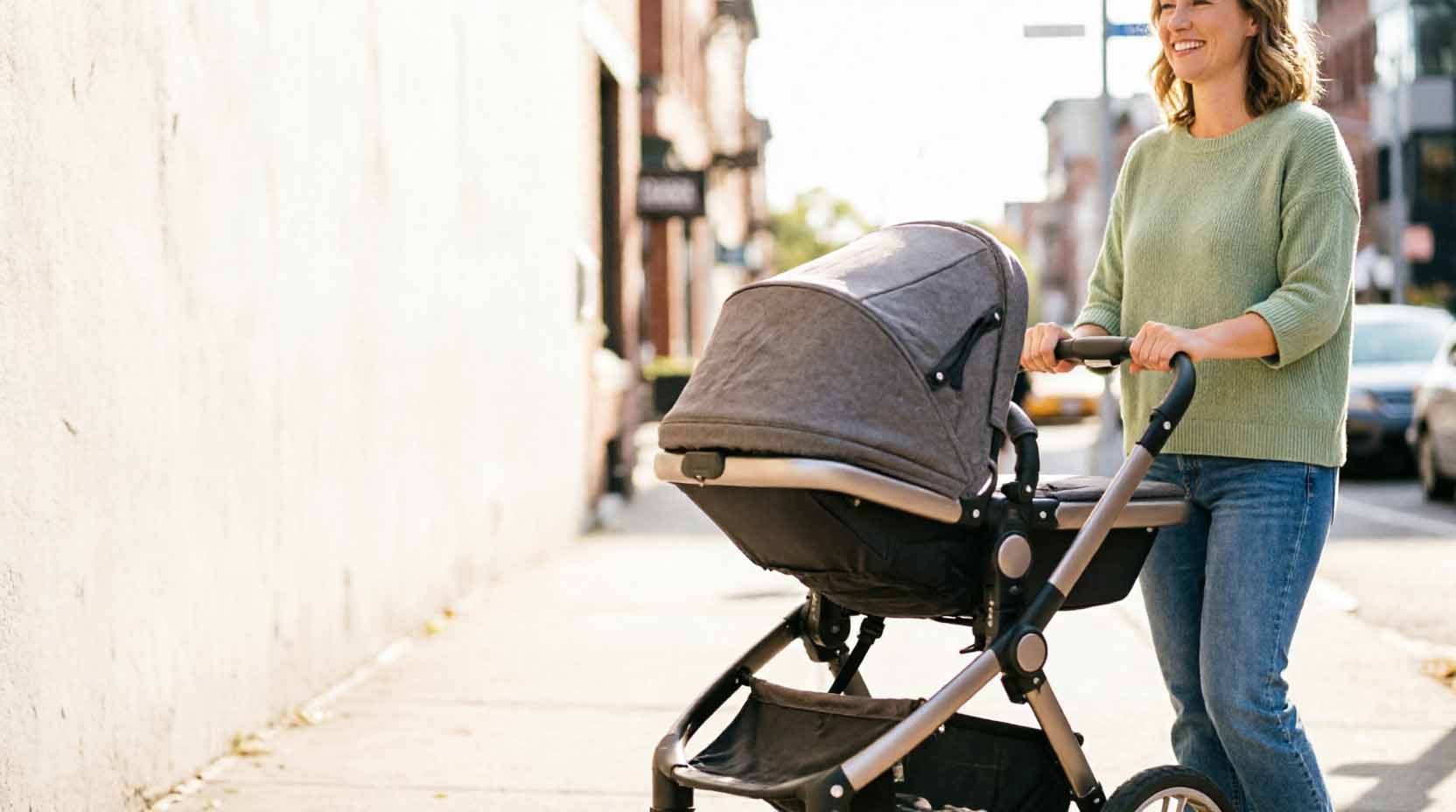
A full-size stroller is built for durability and comfort over years of use but is the heaviest and largest-folding option. A travel system pairs a full-size (or lightweight) stroller frame with a compatible infant car seat that clicks directly into the frame, useful mainly in the first 6–12 months before a child outgrows the infant seat. A lightweight/umbrella stroller trades storage, recline depth, and sometimes suspension quality for portability. It's rarely the right only stroller for a newborn (see the de-marketing section below).
Jogging Strollers: When You Actually Need One
If you're walking or running more than roughly 3 miles per week on pavement or trails, a jogging stroller's fixed or lockable front wheel and larger air- or foam-filled tires (typically 12 inches or larger) genuinely change the ride quality and control at speed. Below that activity level, a standard 3-wheel stroller with a swivel front wheel handles daily errands, store aisles, and sidewalks more easily. The fixed wheel that helps at running speed makes tight turns in a grocery store noticeably harder.
Double and Tandem Strollers for Multiple Kids
Side-by-side doubles are generally easier to maneuver through most doorways but can be too wide for narrow store aisles. Front-and-back tandems are narrower but longer, which changes how they turn and what trunk space they need. Match this to your actual doorways and car trunk, not just the two children's ages. This is exactly what the Trunk Test in the signature framework below is for.
Safety First: What to Verify Before You Buy
Every stroller legally sold in the United States must meet the federal safety standard 16 CFR 1227, which incorporates the ASTM F833 consumer safety performance specification. This covers structural requirements like latching/locking mechanisms to prevent unintended folding, finger-entrapment protection at hinges, and protection against exposed coil springs and sharp edges. A JPMA-certified sticker (Juvenile Products Manufacturers Association) signals an added, voluntary layer of independent testing beyond the federal minimum. It's a meaningful extra signal, but its absence doesn't mean a stroller is illegal or automatically unsafe, since the federal standard is mandatory regardless of JPMA labeling.
3-Step Safety Check Before Every Purchase
- Confirm the harness. Never buy a stroller without a 5-point harness for an infant under roughly 6 months. A 3-point harness doesn't adequately restrain a young infant's upper body.
- Check for the JPMA sticker on the frame as an added confidence signal beyond the mandatory federal standard.
- Search the model number on CPSC.gov's recall database (cpsc.gov/Recalls) before purchase, and again periodically after recalls are issued after a product is already on the market, so checking once at purchase isn't a permanent guarantee.
Scenario anchor: Stroller recalls have historically centered on a small number of recurring hazard patterns: wheel or frame components detaching during use, and finger entrapment at folding hinges, which is exactly what the federal hinge and locking-mechanism requirements above exist to address. This is why the CPSC check matters even for a stroller from a well-known brand: recalls happen across the industry, not just among unfamiliar brands.
Understanding Weight Limits and Age Ranges
Weight limits and minimum ages vary by specific model, not by category. Always check the individual product's manual rather than assuming all "full-size strollers" share the same numbers. As a general pattern, most standard strollers are rated up to roughly 40–50 lbs for the seat, and infant use before about 6 months typically requires either a compatible infant car seat click-in or a stroller seat that reclines close to fully flat with head support. Check both figures on the specific model, since marketing copy sometimes states the maximum weight prominently while burying the minimum age or recline requirement.
Foldability and Portability: The Feature Everyone Underestimates
If a stroller's fold takes more than about 10 seconds or requires two hands while you're also holding a child or a bag, expect it to get skipped in daily use. This is one of the most common gaps between in-store impression and real-world habit. Test the actual fold and unfold motion in-store before buying, not just the seated ride quality.
5 Fold Questions to Ask Before Buying
- Can you fold it one-handed, or does it require two free hands every time?
- Does it self-stand when folded, or does it tip over and need to lean against something?
- Does the auto-lock engage reliably, or does it sometimes need a second attempt?
- How large is the folded footprint? Does it fit your actual trunk, not just an empty one?
- Can you unfold it one-handed from a car trunk without setting anything down first?
One-Hand Fold vs. Two-Hand Fold Mechanisms
A one-hand fold mechanism commonly adds $50–$100 to the price and, because it has more moving parts, can develop wear or misalignment sooner than a simpler two-hand mechanism. For a stroller used daily for errands, that trade-off is usually worth it. A parent juggling a toddler's hand and a grocery bag at the trunk needs a one-hand fold as a functional necessity, not a luxury upgrade. For a stroller that mostly lives folded in the trunk for occasional outings, a cheaper two-hand mechanism is a reasonable way to save money.
Trunk Space and Travel Compatibility
Check the stroller's folded dimensions (not just its open footprint) against your actual trunk space, including room for a stroller travel bag if you plan to check it at an airport gate. Rideshare trunk space varies by vehicle, so a stroller that fits your own car easily may not fit every rideshare you're picked up in. This matters more for double/tandem strollers, which fold to a noticeably larger footprint than singles.
Stroller Buying Mistakes to Avoid
- Buying on aesthetics alone. A stroller's color and silhouette say nothing about fold time, basket capacity, or how it handles your actual doorways and trunk. Test the mechanics, not just the look, before deciding.
- Ignoring car seat compatibility for travel systems. Not every infant car seat clicks into every stroller frame. Check the specific brand/model compatibility list before assuming a "universal" claim applies to your car seat.
- Underestimating long-term cost. Replacement wheels, rain covers, cup holder attachments, and travel bags add up in the budget for accessories beyond the sticker price, especially for jogging and double strollers.
- Buying too early without testing fold/unfold in-store. A stroller that looks fine in photos can have a stiff or unintuitive fold mechanism that only becomes obvious with hands-on use. Test it before your baby arrives, when you have time to return or exchange it if needed.
- Assuming the most expensive option is the safest. Every stroller sold in the US has to clear the same federal safety floor (16 CFR 1227 / ASTM F833). Price above that point buys convenience features, not additional baseline safety.
- Choosing a jogging stroller as an only stroller for occasional, low-mileage walking. The larger frame and fixed wheels that help at running speed make everyday maneuvering in stores and elevators noticeably harder. See the de-marketing section below.
The PickSmartly 3-Test Rule
Before buying any stroller in a store or online, run it through three real-world tests:
- The One-Hand Fold Test: Can you fold it one-handed in under 10 seconds while holding a bag?
- The Curb Test: Can you tilt it up a curb without jolting a sleeping baby awake?
- The Trunk Test: Does it fit folded in your actual trunk alongside a stroller bag or a week's groceries, not just an empty trunk?
If a stroller fails two of these three tests, it's the wrong stroller for daily life, regardless of brand reputation or online reviews. This framework exists because showroom impressions (how it looks, how it pushes on a smooth floor) rarely predict the details that determine whether a stroller actually gets used every day.
Who Should Not Buy Each Stroller Type (Honest Drawbacks)
- Skip a jogging stroller if you walk casually only once or twice a week on paved sidewalks. The larger frame and fixed front wheel make store aisles and elevators harder to navigate, and a standard stroller is more practical for that use pattern.
- Skip an ultra-lightweight umbrella stroller as a first or only stroller for a newborn. Infants under roughly 6 months typically need more recline depth and head support than most umbrella strollers provide. It works well as a second "backup" stroller once a baby is older, not as the primary one from day one.
- Skip paying extra for a one-hand fold mechanism if the stroller mostly lives untouched in the trunk for occasional outings. The added $50–$100 and extra moving parts (which can fail sooner) pay off for daily use, not infrequent use.
- Skip assuming the priciest stroller is the safest choice. Every stroller sold in the US meets the same mandatory federal safety floor. Spending more buys convenience and comfort features, not a higher safety baseline.
Final Verdict: How to Match a Stroller to Your Life
- Mostly walking, stairs, small space? → Lightweight/umbrella, budget $50–$150, but treat it as a second stroller if your child is under 6 months.
- Mostly car-based errands, want one-motion car-seat transfers? → Full-size travel system, budget $200–$600, verify car seat compatibility before buying.
- Running or fast walking 3+ miles/week? → Jogging stroller with a fixed/lockable front wheel and hand brake, budget $250–$700.
- Two children close in age? → Double or tandem, matched to your actual doorways and trunk via the Trunk Test, budget $300–$900.
- Budget under $100 regardless of type? → Prioritize a JPMA-certified lightweight/umbrella model over a cheap full-size stroller. Quality and safety-adjacent features (locking mechanisms, harness fit) drop off faster on low-end full-size strollers than on low-end umbrella strollers.
Run your shortlist through the 3-Test Rule above before deciding. Brand and reviews matter less than whether it passes the fold, curb, and trunk tests for your specific life.
Where to Go Next
Once you've matched a stroller type and confirmed the safety basics above, browse PickSmartly's Baby Product category to apply this framework to specific in-stock options.
For more on how PickSmartly evaluates and scores individual products, see our scoring methodology page. Safety standards referenced in this guide can be verified directly at cpsc.gov/Recalls, and the AAP's guidance on infant equipment safety.
Frequently Asked Questions
Do I really need a travel system, or can I buy the stroller and car seat separately?
You can buy them separately, and it's often cheaper, but check the specific car seat's compatibility with the stroller frame first, since not every combination clicks in securely without a separate adapter. A travel system guarantees compatibility out of the box. Buying separately requires confirming it yourself.
What's the difference between a 3-wheel and 4-wheel stroller?
3-wheel strollers generally turn tighter and handle uneven terrain better, which is why most jogging strollers use this layout. 4-wheel strollers are typically more stable at a stop and often fold more compactly. Neither is universally safer. The right choice depends on your terrain and storage needs.
Can I use a regular stroller for jogging?
Not safely at running speed. A standard swivel front wheel can wobble or lock unpredictably above walking pace. A dedicated jogging stroller's fixed or lockable front wheel and hand brake exist specifically for that use case.
How do I know if a stroller will fit in my car trunk?
Check the stroller's folded dimensions (length, width, height) against your trunk's usable space, ideally with a soft measuring tape rather than eyeballing it, and account for a stroller bag or groceries if you'll need to fit those alongside it, as the 3-Test Rule's Trunk Test above covers.
Is a more expensive stroller actually safer, or just more features?
Every stroller sold in the US meets the same mandatory federal safety standard (16 CFR 1227 / ASTM F833) regardless of price. Spending more typically buys features like lighter weight, smoother suspension, or a faster fold, not a higher baseline safety level.