Water Heater Buying Guide: Tank vs Tankless Costs
Choosing between a tank and a tankless water heater comes down to three numbers: your household's peak hot water demand in gallons per minute, your total installed cost versus tankless's higher price tag, and how many years you'll actually be in the home to recoup that difference. Get those three numbers right, and the rest of the decision falls into place. Get them wrong, and you'll either run cold mid-shower or overpay for efficiency you'll never use.
This guide walks through a five-question framework to match your household to the right unit, breaks down real energy cost differences with sourced numbers, and tells you plainly when tankless is the wrong call. No brand pushing. Just the math.
What's the Real Difference Between Tank and Tankless Water Heaters?
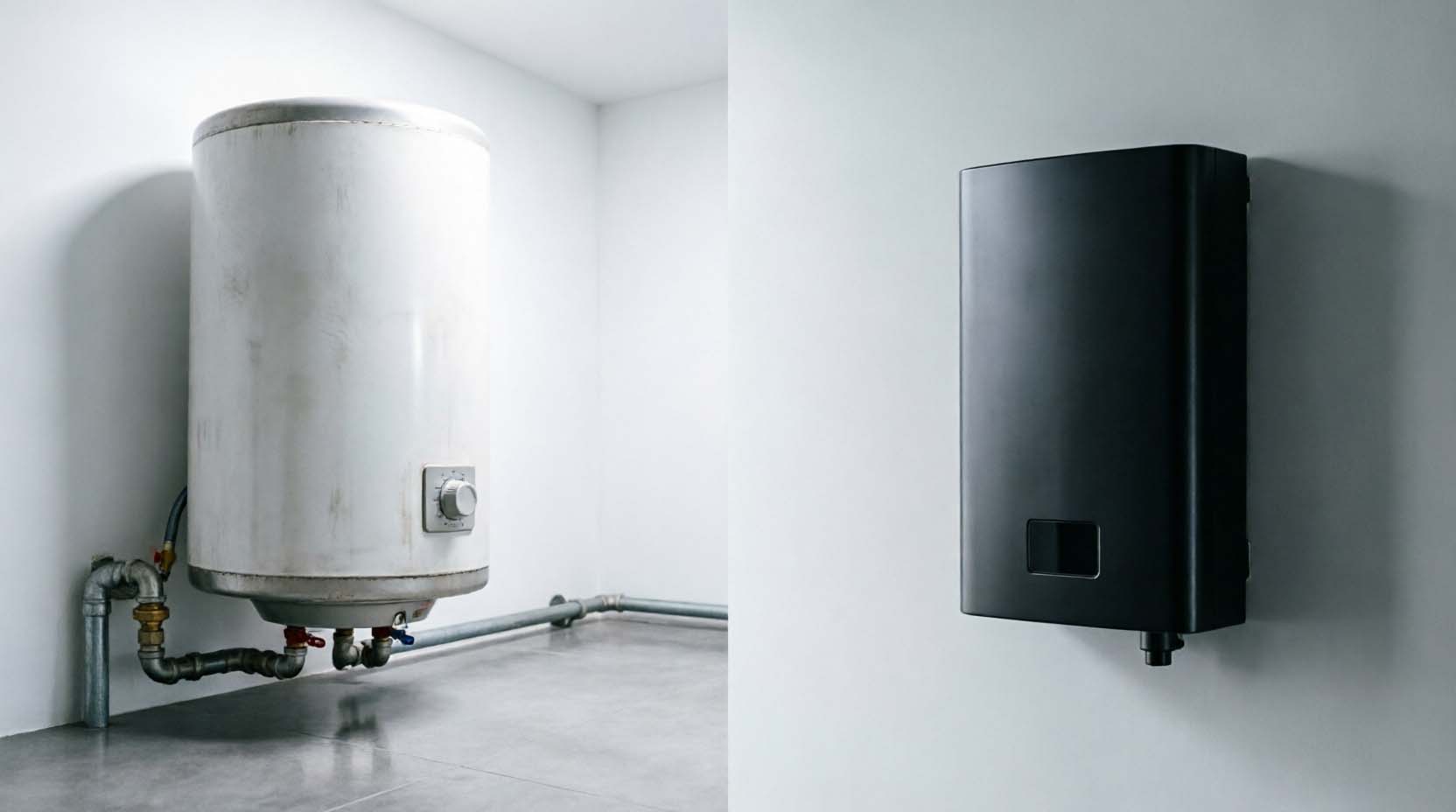
A tank water heater stores 30 to 80 gallons of water and keeps it heated around the clock, ready to draw from whenever you turn on a faucet.
A tankless water heater has no reservoir. It heats water on demand as it flows through a high-output burner or electric element, rated in gallons per minute (GPM) rather than storage capacity.
That single distinction drives almost everything else: cost, install complexity, lifespan, and how the unit behaves under heavy simultaneous use.
Tank sizes commonly run 30 to 80 gallons. Tankless units are rated 2 to 5 GPM for whole-home electric models and 5 to 11 GPM for whole-home gas models. A family of four running a shower and a dishwasher at the same time needs roughly 5 to 6 GPM of combined flow. Keep that number in mind. It comes back in the sizing section below.
|
Factor |
Tank |
Tankless |
|
Upfront + install cost |
$1,000 to $2,500 |
$3,000 to $5,500 |
|
Typical lifespan |
8 to 12 years |
15 to 20 years |
|
Space needed |
Floor space plus clearance |
Wall-mounted, minimal footprint |
|
Standby energy loss |
Yes, continuous |
None |
|
Hot water supply limit |
Runs out when tank is empty |
No volume limit, but flow-rate limited |
|
Best for |
Simultaneous high-demand households, tight budgets |
Steady, moderate demand, long-term homeowners |
The 3-Question Water Heater Fit Test
Before diving into the five-question deep dive, run your household through this quick filter. It's the framework we built this guide around, and it's worth bookmarking.
1. Flow Test. Add up your realistic simultaneous hot water draws- shower plus dishwasher plus laundry- in GPM. If that number regularly tops 5 to 6 GPM, lean toward a tank or a multi-unit tankless setup.
2. Payback Test. Subtract the tank's total install cost from the tankless's total install cost. Divide that difference by your estimated annual energy savings. If the resulting payback period is longer than how many years you plan to stay in the home, tankless probably isn't worth it for you, even though it's the more efficient technology on paper.
3. Space and Climate Test. Got a well-ventilated utility space and a mild-to-moderate climate? A heat pump water heater deserves serious consideration as the highest-efficiency mainstream option. Tight space and cold winters? Rule it out and pick between tank and tankless instead.
How to Choose a Water Heater: 5 Questions to Ask First
1. How many bathrooms and people are in your household?
Household size and bathroom count map directly to the size or flow rate you need.
- 1 to 2 people, 1 bathroom: 30 to 40 gallon tank, or a single tankless unit around 4 GPM
- 3 to 5 people, 2+ bathrooms: 50 to 80 gallon tank, or 6 to 9 GPM tankless, which may require two units or a manifold system
Undersizing here is the single most common regret we hear about from readers who went tankless. If your household sits at the upper end of either bracket, size up rather than splitting the difference.
2. What fuel source do you currently have or can access?
Your existing utility hookups often decide this question before efficiency even enters the conversation.
Switching fuel types adds real cost. Converting from electric to gas-fired tankless typically adds $1,500 to $3,000 for a new gas line and venting. Electric tankless units, meanwhile, often demand a 150 to 200 amp panel upgrade, which can run $2,000 or more in older homes.
A homeowner in an all-electric condo faces a very different path than one with existing gas service already run to the utility closet. If you don't have the fuel type your ideal unit needs, factor that conversion cost into your decision before you fall in love with a spec sheet.
3. What's your peak simultaneous hot water demand?
This is where the flow-rate ceiling of tankless units actually matters. Add up what you'd realistically run at once:
- Shower: 2.0 to 2.5 GPM
- Dishwasher: 1 to 2.5 GPM
- Washing machine: 1.5 to 3 GPM
- Kitchen faucet: 1.5 GPM
Two showers running while the dishwasher cycles can push past 6 GPM fast. A single tankless unit rated at 5 GPM will simply throttle or run lukewarm under that load. This isn't a defect. It's a hard physical ceiling, and it's the number one thing generic buying guides gloss over.
4. What's your budget: upfront cost vs total cost of ownership?
Sticker price and ten-year cost are two different questions, and conflating them is how people end up disappointed either way.
Tank units typically install for $1,000 to $2,500 total. Tankless typically installs for $3,000 to $5,500 total, and that climbs higher if you're retrofitting venting, gas lines, or electrical service.
Rule of thumb: tankless usually breaks even on that higher install cost around year 7 to 12, depending on fuel prices and how much hot water your household actually uses.
5. How much space do you have, and what's your climate?
Tanks need floor space plus clearance around them. Tankless mounts on a wall, freeing up closet or utility space entirely, which matters a lot in smaller homes.
Climate changes tankless performance more than most buyers expect. In regions where incoming groundwater runs 40°F or colder, a tankless unit's rated GPM can drop by roughly 30 to 40% compared to its rated output at 77°F groundwater. A unit rated for 6 GPM in a warm climate might realistically deliver closer to 4 GPM in a Minnesota winter. Size accordingly if you live somewhere cold.
Tank vs Tankless: Energy Costs Compared
Storage tanks lose energy to standby loss, meaning they keep a full tank hot 24/7 even when nobody's home. That loss is real, but it's often overstated relative to total household energy use.
According to ENERGY STAR-certified tankless gas units, they run roughly 8 to 14% more energy efficient than standard storage tank gas units for average-use households, and that gap widens to roughly 22 to 34% more efficient for low-use households, per DOE-referenced efficiency factors. In other words, if your household runs the dishwasher, laundry, and multiple showers daily, tankless's efficiency edge is real but modest. If you're a single occupant using hot water sparingly, the gap widens considerably in tankless's favor.
Heat pump (hybrid) electric water heaters deserve their own callout here. They can use roughly 60 to 70% less electricity than standard electric resistance tanks, which often makes them the best "hidden" option for anyone focused purely on minimizing operating cost, assuming you have the space and climate for one.
|
Water Heater Type |
Relative Annual Operating Cost |
|
Standard electric tank |
Highest |
|
Gas tank |
Moderate-high |
|
Tankless gas |
Moderate |
|
Tankless electric |
Moderate |
|
Heat pump / hybrid electric |
Lowest |
These are relative comparisons, not fixed dollar figures, because local utility rates and household usage swing actual bills significantly. Check your current electricity and gas rates before running your own payback math.
Are There Still Tax Credits or Rebates for Water Heaters?
Here's a fact worth getting right before you shop: the federal Energy Efficient Home Improvement Credit (Section 25C), which previously covered 30% of qualifying heat pump water heater costs up to $2,000 per year, was repealed by the One Big Beautiful Bill Act. It expired for any equipment placed in service after December 31, 2025.
Federal tax credit note: The federal 25C credit for water heaters ended December 31, 2025. Check dsireusa.org or your utility provider for any state or local rebates still available in your area.
State and utility-level rebates still vary widely by location. Use ENERGY STAR's rebate finder and DSIRE (dsireusa.org) to check what's currently available where you live rather than assuming a national incentive applies.
Types of Water Heaters Beyond Tank and Tankless
A few other categories round out the field, though most readers land on tank, tankless, or heat pump.
- Heat pump (hybrid) water heaters: Best for garages or basements with surrounding air space. They need a room of roughly 700+ cubic feet to draw ambient heat efficiently. Drawback: slower recovery after heavy use, and they don't perform well in tight closets.
- Solar water heaters: Best for sunny climates with a backup heating element for cloudy stretches. Drawback: high upfront cost and roof space requirements limit who this actually works for.
- Condensing gas tank units: Best for households wanting gas tank convenience with better efficiency than standard models. Drawback: higher upfront cost than a standard gas tank, with modest efficiency gains in return.
Deep dives on each of these belong in their own dedicated guides. For now, know they exist and where they fit before you default to tank or tankless out of habit.
How Long Do Water Heaters Last, and When Should You Replace vs Repair?
Tank water heaters typically last 8 to 12 years. Tankless units typically last 15 to 20 years with proper maintenance, which for tankless specifically means annual descaling in hard-water regions.
Rule of thumb: if your tank unit is 8 or more years old and a repair would cost more than 50% of a new unit's install price, replace it instead of repairing it. Sinking money into an aging unit rarely pays off once you cross that threshold.
Common Mistakes to Avoid When Choosing a Water Heater
- Undersizing tankless for actual household simultaneous demand, not just average use
- Ignoring water hardness, which accelerates scaling inside a tankless heat exchanger and shortens its life
- Skipping permits or code checks on gas line and venting work
- Choosing based on upfront price alone instead of total cost of ownership over the unit's lifespan
- Assuming tankless "never runs out" means it can handle unlimited simultaneous fixtures, which it can't
Who Should Skip Tankless Entirely
Radical honesty time. Tankless isn't the right call for everyone, and a few groups should think twice.
Skip tankless if you're in a hard-water region without a softener. Scaling inside the heat exchanger shortens lifespan and drags down efficiency fast, undermining the entire value proposition.
Skip tankless if you're on a tight budget and won't stay in the home long enough to recoup the install premium. If you're planning to sell within 3 to 5 years, that higher upfront cost likely won't pay itself back before you move.
Skip tankless if a gas line or electrical upgrade would erase most of your long-term savings. Run the payback math from the Fit Test above before committing to a fuel conversion.
On the flip side, if efficiency is your top priority and you're defaulting to a basic electric resistance tank purely because it's cheapest upfront, know that it's usually the least energy-efficient mainstream option available. A heat pump unit will cost more to install but less to run, assuming you have the space for it.
Buyer Decision Checklist
- Calculated your household's peak simultaneous GPM demand
- Confirmed your existing fuel source and whether a conversion is needed
- Checked your local groundwater temperature if considering tankless
- Run the Payback Test against how long you plan to stay in the home
- Verified you have adequate space and ventilation for a heat pump unit, if considering one
- Checked dsireusa.org for current state or utility rebates
Frequently Asked Questions
Is a tankless water heater really worth the extra cost?
It depends on your payback timeline. If the higher install cost breaks even within how long you'll stay in the home, generally somewhere in the 7 to 12 year range, it's worth it. If you'll move sooner than that, a tank likely makes more financial sense.
Will a tankless water heater run out of hot water?
No, not in the way a tank does. But it can get outpaced by simultaneous demand exceeding its GPM rating, which feels similar to running out even though the mechanism is different.
Do I need a bigger electrical panel or gas line for tankless?
Often yes, especially if you're converting fuel types. Budget $1,500 to $3,000 for gas line and venting work, or $2,000+ for an electrical panel upgrade in older homes.
How much does it cost to install a tankless water heater?
Expect $3,000 to $5,500 total, higher if you need venting, gas line, or electrical work. Costs vary by region and local labor rates, so get a local quote before budgeting.
Are heat pump water heaters worth it in a cold climate?
Performance drops in cold ambient air since these units pull heat from surrounding air. They work best in moderate climates with a warm, ventilated space like a basement or garage. Verify climate suitability before installing, especially in colder northern regions.
What size water heater do I need for a family of 4?
A 50 to 80 gallon tank, or a tankless system rated 6 to 9 GPM, possibly requiring two units or a manifold setup for 2 or more bathrooms.
Is it cheaper to repair or replace an old water heater?
If your unit is 8 or more years old and repair costs exceed 50% of a new unit's install price, replace it. Below that threshold, repair usually makes more financial sense.