How to Choose a Pressure Washer for Cars, Decks, and Siding
Buy the wrong PSI, and you risk two outcomes: a hood with stripped clear coat, or a deck board gouged down to raw wood. Buy underpowered, and you'll be scrubbing driveway grime by hand anyway. The fix isn't finding "the best pressure washer." It's matching Cleaning Units (PSI multiplied by GPM) to your specific surface, then confirming the fit with a quick test patch before you commit to the whole job.
This guide walks through that framework surface by surface, so you land on the right machine the first time.
PSI vs. GPM: The Two Numbers That Actually Matter
Every pressure washer listing throws PSI at you like it's the only spec that matters. It isn't.
PSI (pounds per square inch) measures force- how hard the water hits a surface. GPM (gallons per minute) measures volume: how much water moves through the nozzle. PSI alone is a marketing trap because a high-PSI, low-GPM machine can clean slower and less effectively than a moderate-PSI unit with strong flow.
The number that actually predicts cleaning performance is Cleaning Units (CU):
CU = PSI × GPM
Two machines can both advertise "3,000 PSI," but if one delivers 1.5 GPM and the other delivers 2.5 GPM, the second one is doing roughly 67% more actual cleaning work per minute. That gap shows up fast on a dirty driveway or a mildewed fence.
CU Benchmark Tiers
|
CU Range |
Classification |
Typical Tasks |
|
Under 2,000 CU |
Light duty |
Cars, patio furniture, small decks, screens |
|
2,000–5,000 CU |
Mid duty |
Full decks, fences, vinyl siding, mid-size driveways |
|
5,000+ CU |
Heavy duty |
Large driveways, commercial siding jobs, stripping paint |
If you're only washing a sedan and a 200-square-foot patio, a 5,000+ CU machine isn't a safety net. It's overkill that raises your risk of damage every time you pick up the wand.
Electric vs. Gas Pressure Washers: Which Fits Your Use Case
Electric models typically top out around 1,900 to 2,300 PSI. They're quieter, need almost no maintenance, and plug straight into an outlet. For cars and light deck work, that's plenty of power.
Gas models start around 2,300 PSI and climb past 4,000 PSI on commercial-grade units. They require fuel, oil changes, and more storage space, but they clear large driveways and heavy siding jobs in a fraction of the time.
|
Factor |
Electric |
Gas |
|
Power range |
Up to ~2,300 PSI |
2,300 PSI and up |
|
Noise level |
Quiet, apartment-friendly |
Loud, engine-driven |
|
Maintenance |
Minimal, no oil or fuel |
Regular oil changes, fuel storage |
|
Best for |
Cars, patios, small decks |
Driveways, large siding jobs, farms |
|
Price range |
$100 to $300 |
$250 to $700+ |
Rule of thumb: if your longest job is under 500 square feet and you don't own a truck or trailer to wash, go electric. Anything larger, or anything involving years of caked-on grime, go gas.
The Safe PSI Range for Washing a Car
A car's clear coat is thinner than most people assume, often less than two mils thick, roughly the width of a sheet of paper. Pressure washer nozzles concentrate force into a narrow stream, and at close range that stream can cut through clear coat in seconds.
Professional detailers generally stay within 1,200 to 1,900 PSI, held at least 12 to 24 inches from the panel, using only a 25° or 40° nozzle. Never point a 0° (red) nozzle at a vehicle. That tip is designed for concrete, not paint.
5 Rules for Pressure Washing Your Car Safely
- Keep PSI at or below 1,900, even if your machine can go higher
- Use only a 25° or 40° nozzle, never 0° or 15°
- Hold the wand at least 12 inches from the surface, ideally closer to 24
- Work top to bottom in overlapping passes, never lingering in one spot
- Rinse from a moving angle, not a fixed straight-on blast
Best Nozzle Tips and Attachments for Vehicles
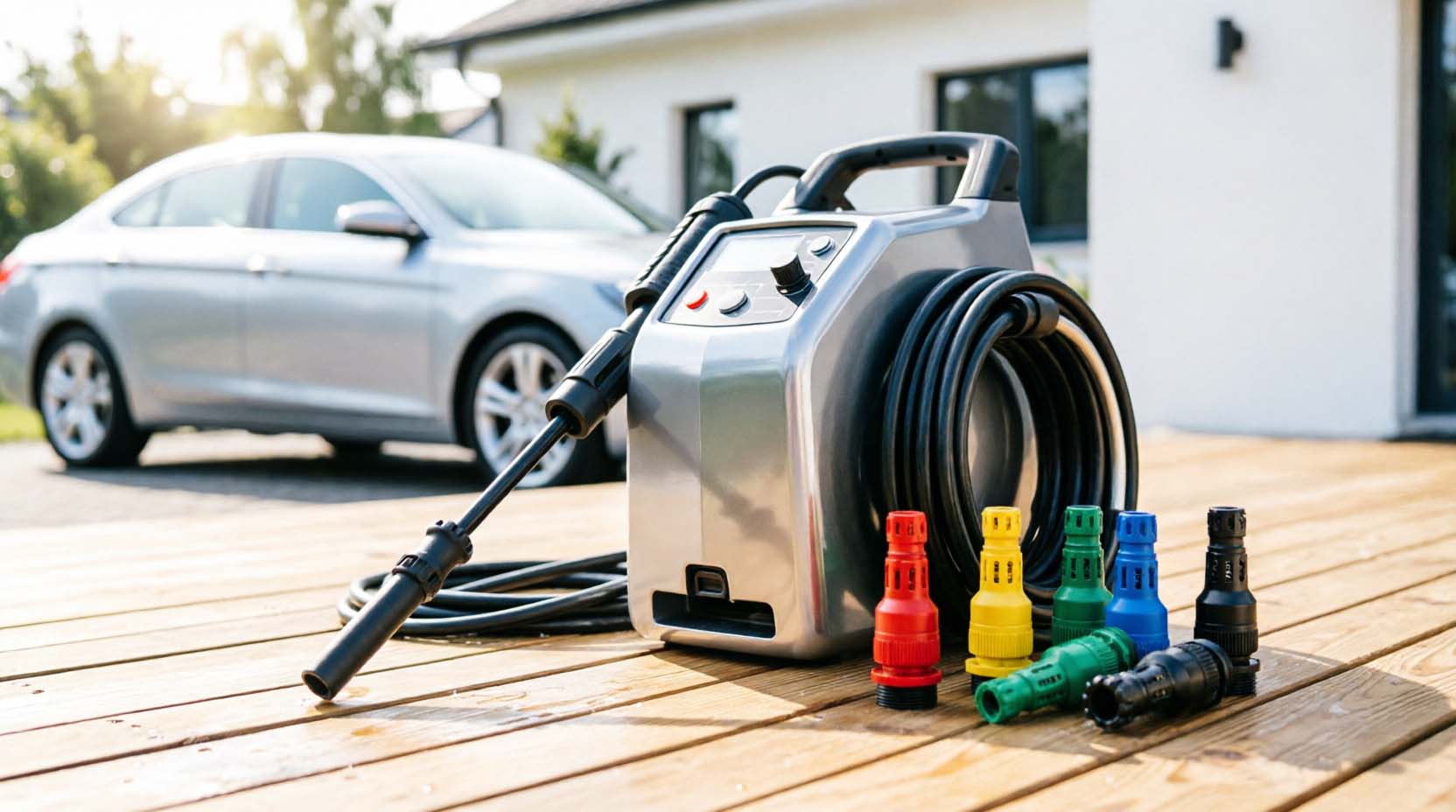
Pressure washer nozzles are color-coded by spray angle, and knowing the code prevents most accidental damage before it happens.
|
Color |
Angle |
Use Case |
Car Safe |
|
Red |
0° |
Concrete, rust removal |
No |
|
Yellow |
15° |
Stripping paint, tough stains |
No |
|
Green |
25° |
General cleaning, siding |
Yes, with distance |
|
White |
40° |
Cars, delicate surfaces |
Yes |
|
Black |
Low pressure, soap only |
Foam cannon, pre-soak |
Yes |
A foam cannon attachment is worth adding to your cart if you're serious about car care. It applies a thick soap layer at low pressure before you rinse, lifting grime off the surface instead of grinding it in with direct spray. Most detailers treat this as a pre-wash step, not a replacement for the rinse itself.
Choosing the Right PSI for Wood, Composite, and Painted Decks
Wood decking fights back differently than a car panel. Instead of cutting through a coating, excess pressure fuzzes and gouges the wood grain itself, tearing up soft fibers and leaving a rough, splintery surface that no amount of sanding fully corrects.
Soft woods like cedar and pine are the most vulnerable. Hardwoods like ipe tolerate more force, but even they have limits.
For most residential wood decks, stay within 500 to 1,200 PSI, using a 25° or 40° fan tip, held 8 to 12 inches from the boards. Always test an inconspicuous corner first: a step, a corner behind a planter, anywhere off the main sightline.
Before You Wash: Check Your Deck Manufacturer's PSI Limit
Composite decking, Trex-style boards included, has its own tolerance range set by the manufacturer. Many composite brands void their warranty for damage caused by pressure above 3,100 PSI at close range. Check your specific manufacturer's cleaning guidance before you start, since composite formulations vary by product line and year.
Prepping a Deck for Staining or Sealing
If you're washing a deck to prep it for stain or sealant, lighter pressure preserves the wood grain you're about to seal in.
- Clear the deck of furniture, rugs, and planters completely
- Wash with 500 to 800 PSI using a wide 40° fan angle
- Work with the grain, not across it, in slow overlapping passes
- Let the deck dry fully, typically 24 to 48 hours, before staining
Pressure Washing Vinyl, Wood, Brick, and Stucco Siding Safely
Vinyl siding fails in a way that's easy to miss until it's already a problem. Too much pressure, or an upward spray angle, can force water behind the panels. That trapped moisture leads to mold and rot inside the wall cavity, damage you won't see until months later when a panel starts to warp, or a musty smell shows up indoors.
Stay within 1,300 to 1,600 PSI for vinyl siding, using a 40° nozzle at minimum, and always spray at a downward or level angle, never upward. Brick and stucco tolerate more force, generally up to 3,000 PSI, but grout lines and mortar joints remain vulnerable and can erode with repeated close-range blasting.
Surface Comparison Table
|
Surface |
Safe PSI |
Nozzle Angle |
Spray Direction |
Key Warning |
|
Vinyl siding |
1,300–1,600 |
40° |
Downward or level |
Never spray upward. Water intrusion risk |
|
Wood siding |
500–1,200 |
25° or 40° |
Level, with the grain |
Fuzzes and splinters under excess pressure |
|
Brick/stucco |
1,500–3,000 |
25° or 40° |
Level |
Grout and mortar erode with close-range hits |
The Master Surface-by-Surface PSI and Nozzle Reference Table
Bookmark this table. It's the fastest way to check a setting before you pull the trigger on any surface in this guide.
|
Surface |
Safe PSI Range |
Recommended Nozzle |
Min. Distance |
Key Warning |
|
Car / Vehicle |
1,200–1,900 |
25° or 40° |
12–24 in |
Never use a 0° nozzle. It strips clear coat |
|
Wood Deck |
500–1,200 |
25° or 40° |
8–12 in |
Excess PSI fuzzes and gouges soft grain |
|
Composite Deck |
Under 3,100 |
25° or 40° |
8–12 in |
Check manufacturer limit, warranty risk |
|
Vinyl Siding |
1,300–1,600 |
40° |
12–18 in |
Never spray upward. Traps moisture behind panels |
|
Wood Siding |
500–1,200 |
25° or 40° |
10–14 in |
Same fuzzing risk as wood decking |
|
Brick / Stucco |
1,500–3,000 |
25° or 40° |
10–12 in |
Grout lines erode with prolonged close contact |
|
Concrete / Driveway |
3,000–4,000 |
0° or 15° |
6–10 in |
Fine for concrete. Never use these tips on any other surface |
Other Features That Matter Beyond PSI
PSI and GPM get the headline attention, but a handful of secondary specs decide whether a machine is actually pleasant to use for years.
Quick Spec Checklist
- Hose length: 25 to 35 feet lets you cover a full driveway or deck without repositioning constantly
- Detergent tank: Built-in tanks save you from juggling a separate soap dispenser attachment
- Wheels and portability: Look for large wheels if you're moving the unit across gravel or grass
- Cord length (electric): 30-plus feet reduces how often you need an extension cord
- Warranty length: 2 to 3 years on the pump signals a manufacturer confident in build quality
Who Should NOT Buy a High-PSI Pressure Washer
Most buying guides skip this section entirely. It's the one that actually saves readers money and property damage.
- Apartment or condo dwellers: Many HOAs restrict gas engine noise and exhaust, and storing fuel in a small unit is a real hazard. Go electric, and check your lease before buying anything gas-powered.
- Car-only owners: If your only use case is washing a vehicle, a 3,000-plus PSI gas unit is more machine than you need, and it raises your risk of an expensive paint mistake every time you use it.
- Owners of older or weathered wood decks: Aged wood has already lost structural integrity in its surface fibers. No amount of skill or nozzle choice fully offsets that. Hand washing or professional soft washing is the safer call here.
- Owners of older vinyl siding: Siding installed more than 15 to 20 years ago is more prone to cracking and seam separation. A lower-pressure hand wash avoids forcing the issue.
Buying more PSI "to be safe" is backwards logic. Too much pressure is the actual damage risk, not too little. A weaker machine and a longer wash time cost you an extra 20 minutes. A machine that's too strong can cost you a deck board or a body panel.
Final Verdict: How to Match Your Pressure Washer to Your Actual Needs
Three scenarios cover most households:
- Mixed-use household (cars, deck, and siding): choose a mid-duty electric or entry gas unit in the 2,000 to 3,000 CU range, and swap nozzles by task rather than buying separate machines.
- Car-only owner: an electric unit under 2,000 PSI with a 40° nozzle and foam cannon attachment covers everything you need.
- Deck and siding-only owner: a gas unit in the 2,300 to 3,000 PSI range gives you enough reach for siding without overpowering wood surfaces, as long as you dial pressure down with the nozzle for the deck itself.
Whatever machine you land on, run PickSmartly's CU plus test patch rule before every new job. Multiply PSI by GPM to know what the machine can do. Then test a hidden three-second patch on the actual surface in front of you. The spec sheet tells you the machine's ceiling. The test patch tells you what your specific car, deck, or siding section can actually handle that day.
Frequently Asked Questions
Will a pressure washer damage my car's paint?
Yes, if used incorrectly. A 0° nozzle held closer than 12 inches can cut through clear coat in seconds. Stick to 1,200 to 1,900 PSI with a 25° or 40° nozzle, held at least 12 inches away, and the risk drops to nearly zero.
What PSI is safe for a wood deck?
Keep pressure between 500 and 1,200 PSI with a wide 25° or 40° fan tip. Higher settings fuzz and gouge the wood grain, especially on softer woods like cedar or pine. Always test a hidden corner first.
Can I use the same pressure washer for my car and my siding?
Yes, as long as the machine's PSI range covers both needs and you switch nozzles between tasks. A mid-duty unit around 2,000 to 3,000 PSI, paired with a 40° nozzle for the car and a 25° nozzle for siding, handles both jobs safely.
Is electric or gas better for occasional home use?
Electric suits most occasional users. It's quieter, needs no fuel storage, and covers cars, patios, and small decks up to about 2,300 PSI. Gas only makes sense if you're covering large driveways or heavy siding jobs regularly.
How far should I stand from vinyl siding when pressure washing?
Stay at least 12 to 18 inches away using a 40° nozzle, and always spray at a downward or level angle. Spraying upward can force water behind the panels, leading to hidden mold growth inside the wall.
Do I need a surface cleaner attachment?
Only if you're regularly cleaning large flat areas like driveways or patios. A surface cleaner spreads pressure evenly across concrete, preventing the streaky lines a wand leaves behind, but it isn't necessary for cars, decks, or siding.
What's the difference between PSI and GPM?
PSI measures force- how hard the water hits a surface. GPM measures volume: how much water flows through the nozzle per minute. Multiplying the two gives you Cleaning Units, a better predictor of real cleaning power than PSI alone.