What Is a Smart Scale and Is It Worth Buying?
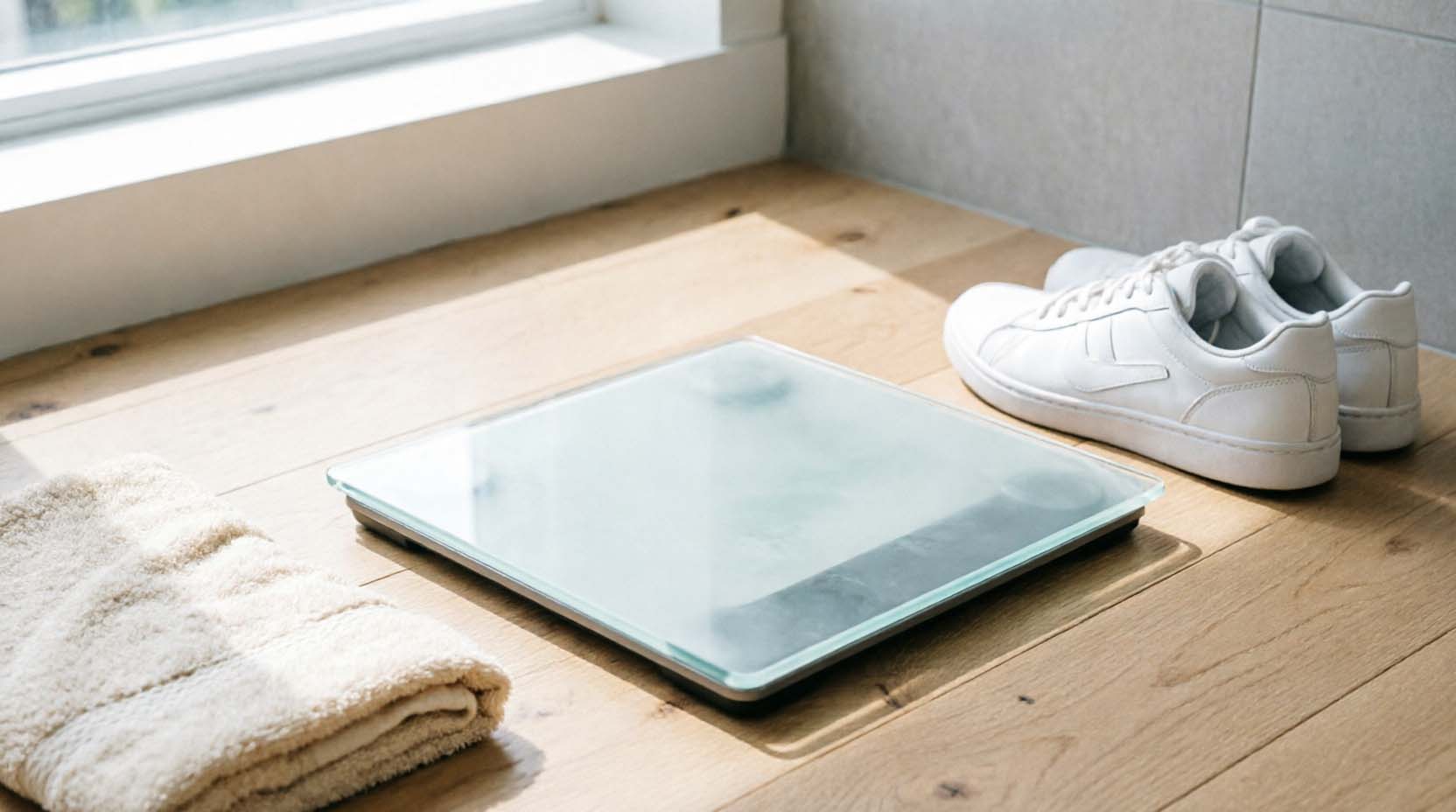
A smart scale is a bathroom scale that syncs to an app over Bluetooth or Wi-Fi. It logs your weight automatically and estimates body fat, muscle, and water. It is worth buying if you want hands-free weight trend tracking. Treat the body fat and muscle numbers as rough estimates.
Key takeaways
- Weight readings are reliable. Body composition readings are loose.
- Body fat can swing 1 to 3 percentage points in a day from hydration alone.
- If you weigh in fewer than 3 times a week, a basic $15 to $25 scale is enough.
- Follow the Trend Over Number Rule below to get useful data.
You have probably jotted your weight in a notes app for three weeks. Then one salty dinner added 2 lb overnight and made the whole log look wrong. A smart scale fixes the logging. It does not fix the noise, and that gap is where most buyers get misled.
What Is a Smart Scale? (Plain-English Definition)
A smart scale is a digital bathroom scale with wireless connectivity. It sends each reading to a phone app, so you never type a number by hand. Most models also estimate body fat, muscle mass, body water, and bone mass.
Think of it as a kitchen scale that also texts your phone. The weighing part is old technology. The app and the estimates are the new parts.
Weight accuracy on a decent model is typically within about 0.4 to 1 lb. The body composition numbers are much looser, and we cover why below.
How a Smart Scale Works (Load Cells and Bioimpedance)
Two systems do the work.
- Load cells sit in the scale's feet. They flex slightly under your weight and turn that flex into a number.
- Metal electrodes on the surface send a tiny, harmless electrical current up one leg and down the other.
- The scale measures how much the current is slowed. This method is called bioelectrical impedance analysis (BIA).
- Water-rich muscle conducts current easily, while fat resists it.
- The app plugs that resistance into a formula using your height, age, and sex to guess your body fat.
Here is a garden hose analogy. You can judge a hose's contents by how easily water flows through it. That tells you something but not everything, especially if the hose is dry, wet, or oddly shaped.
Smart Scale vs Regular Scale
A basic scale gives you the same weight number for far less money. A smart scale adds convenience and estimates.
- Cost: Basic scales run roughly $15 to $25. Smart scales start near $20 to $30 and reach $200.
- Logging: A regular scale needs manual entry. A smart scale syncs on its own.
- Users: Smart scales store multiple profiles, so a household shares one device.
- Body composition: Only smart scales estimate it, and only roughly.
- Downsides: Smart scales add apps, account logins, and privacy questions.
How Accurate Are Smart Scales? (Lab Claims vs Real Life)
Weight is reliable. Body fat is a guess. Consumer BIA scales commonly differ from a DEXA scan, the clinical reference method, by several percentage points. Very lean users, athletes, and very heavy users tend to see larger misses.
The lab spec sheet describes ideal conditions. Real bathrooms are different. Here is what moves the number:
- Hydration: A big glass of water or a dehydrating night can shift body fat by 1 to 3 percentage points.
- Meals: Eating shifts fluid distribution and changes the reading.
- Workouts: Weigh yourself before and after a 60-minute run, and you will see two different body fat numbers.
- Foot dryness: Dry or callused soles reduce electrical contact.
- Floor surface: Carpet throws off the load cells, which can add or subtract a pound or more.
What to trust: Weight and weight trends over weeks.
What to treat cautiously: Body fat percentage, muscle mass, visceral fat, and "body age."
That "body age" number is the weakest of the lot. It is a marketing score built from the other estimates. Ignore it.
The Trend Over Number Rule
This is the PickSmartly method for getting real value from a smart scale. Trust the direction, not the single reading.
- 7 readings. Look at the 7-day average, never one weigh-in.
- 1 condition. Weigh under the same conditions each time. Use mornings, after the bathroom, before eating, on the same hard floor spot.
- 4 weeks. Judge body composition changes only over 4 weeks or more. Day-to-day noise can be bigger than real change.
A 2 lb jump after a salty dinner will vanish in a weekly average. That is the whole point.
Is a Smart Scale Worth Buying? (Our Verdict by User Type)
Yes, for people who track over months and use the app. No, if you weigh in rarely or the daily number stresses you out.
The test is the 3-Weigh-Ins Rule. If you weigh in fewer than 3 times per week, or you will not open an app, a basic $15 to $25 scale is enough. Skip the upgrade.
- Weight loss: Worth it. Automatic trend graphs beat a notebook.
- Strength training: Worth it for weight and rough trends only. Do not chase the muscle mass number.
- Families: Worth it. Separate profiles keep everyone's data apart.
- Older adults: Worth it if the display is large and the app is simple. Otherwise choose a basic scale.
- Tight budget: Buy a basic scale, or a sub-$30 Bluetooth model at most.
Who Benefits Most
Picture someone losing 20 lb over 6 months. They want a weekly trend line without typing anything. A smart scale gives them that on day one, and it costs about as much as a couple of takeout meals.
Who Should Skip a Smart Scale
Safety note: BIA scales send a small electrical current through the body. People with pacemakers or implanted defibrillators should not use them unless a doctor approves. Pregnant women should ask a healthcare provider first. This is general guidance and not medical advice.
Skip it, or use it cautiously, in these cases:
- You have an implanted electrical medical device.
- You have a history of disordered eating or weight-related anxiety. Daily numbers can trigger unhealthy habits. A weekly weigh-in on a basic scale is gentler.
- You are an elite athlete or very lean. Body fat readings can be misleading.
- You will never open the app. You are paying for features you will not use.
What to Look for in a Smart Scale (Buyer Checklist)
Use these pass/fail thresholds before you click buy.
- Weight capacity: At least 350 lb if there is any doubt. Many budget models stop at 396 lb, but check.
- Connectivity: Choose Wi-Fi for hands-free sync from anywhere in the house. Choose Bluetooth if your phone sits nearby when you weigh in.
- Health app sync: Confirm it connects to Apple Health, Google Health Connect, Fitbit, or Garmin, whichever you use.
- Profile slots: A 4-person household needs at least 8 slots to leave room for guests. A couple can use a 5-profile model.
- Subscription: Skip any scale that demands a paid plan for basic weight tracking.
- App support: Skip any brand with no app update in the last 12 months.
- Data export: Look for CSV export or health platform sync so your history is not trapped.
- Power: Note whether it uses AAA batteries or USB charging, and how often you will need to replace them.
Also read the app's privacy policy. Some apps share data with third parties.
Smart Scale Options Compared
Prices change often. Verify the current model, price, and app compatibility on Amazon before you order.
|
Model |
Best for |
Connectivity |
Health app sync |
Approx. price |
Main drawback |
|
RENPHO Elis 1 |
Budget buyers |
Bluetooth |
Apple Health, Google Health Connect, Fitbit |
$25 to $40 |
Body fat estimates are basic |
|
Eufy Smart Scale P2 Pro |
Mid-range Wi-Fi users |
Wi-Fi and Bluetooth |
Apple Health, Google Health Connect, Fitbit |
$50 to $70 |
App is decent but less polished than premium rivals |
|
Withings Body+ |
Families and data fans |
Wi-Fi and Bluetooth |
Apple Health, Google Health Connect |
$90 to $110 |
Costs 3 times more than a budget model |
|
Fitbit Aria Air |
Fitbit users |
Bluetooth |
Fitbit ecosystem |
$40 to $60 |
Weight only, with no body fat estimate |
|
Garmin Index S2 |
Garmin watch owners |
Wi-Fi and Bluetooth |
Garmin Connect |
$150 to $200 |
Priciest option, and it pays off mainly inside Garmin's ecosystem |
Our default advice is simple. Start with a budget Bluetooth model. Upgrade to Wi-Fi only if you keep forgetting to open the app. A higher price does not buy a better body fat estimate. Most consumer scales use similar BIA technology.
How to Set Up and Use a Smart Scale for Reliable Data
Setup takes about 10 minutes. Consistency after that is what counts.
- Place the scale on a hard, flat floor. Avoid carpet and uneven tiles.
- Install the batteries and download the manufacturer's app.
- Pair over Bluetooth or connect to your 2.4 GHz Wi-Fi network. Many scales cannot join 5 GHz networks.
- Enter your height, age, and sex accurately. The body fat formula depends on them.
- Create a profile for each user and link the scale to Apple Health or Google Health Connect if you want.
- Step on barefoot with dry feet, stand still, and keep your weight centered.
- Weigh at the same time daily, ideally first thing in the morning after using the bathroom.
- Check your 7-day average weekly, and ignore single-day readings.
Method note: These steps follow common manufacturer guidance. Menus vary by brand, so confirm details in your model's manual. Add your own photos and two-week log if you publish from personal testing.
Common Smart Scale Myths
- Myth: Body fat numbers are lab-grade. Fact: They are estimates and can miss by several percentage points compared with DEXA.
- Myth: A higher price means a more accurate body fat reading. Fact: Most consumer scales use similar sensors and formulas.
- Myth: A smart scale will help me lose weight by itself. Fact: It only measures. Habits do the work.
- Myth: Daily fluctuations mean something is wrong. Fact: Water, food, and sodium routinely move your weight by 2 to 4 lb in a day.
Which Path Fits You? A Quick Decision Tree
- Do you weigh in fewer than 3 times per week? Yes, buy a basic $15 to $25 scale. No, go to step 2.
- Do you have a pacemaker or implanted device, or are you pregnant? Yes, ask your doctor before using any BIA scale. No, go to step 3.
- Does daily weighing make you anxious? Yes, use a basic scale weekly. No, go to step 4.
- Do more than 2 people share the scale? Yes, pick a model with 8 or more profiles. No, go to step 5.
- Do you own a Garmin or Fitbit device? Yes, consider that brand's scale for smoother sync. No, go to step 6.
- Is your budget under $40? Yes, pick a budget Bluetooth model. No, choose a Wi-Fi model in the $50 to $110 range.
Bottom Line
A smart scale is worth buying if you weigh in 3 or more times a week and will use the app. It is a convenience tool for weight trends. It is not a lab.
The Trend Over Number Rule: 7 readings, 1 condition, 4 weeks.
Your next three steps:
- Run the decision tree above to pick a tier.
- Buy a budget Bluetooth model first. Upgrade only if you hit a real limit.
- Weigh under the same conditions daily and judge your progress by the 7-day average.
Frequently Asked Questions
What is a smart scale in simple terms?
It is a bathroom scale that connects to a phone app. It logs your weight automatically and estimates body fat, muscle, and water. You get trend graphs without typing anything.
How does a smart scale measure body fat?
It sends a small electrical current through your feet and measures resistance. Fat slows current more than muscle. The app converts that into an estimate using your height, age, and sex.
Are smart scales accurate?
Weight readings are typically within about 0.4 to 1 lb. Body fat readings often differ from DEXA by several percentage points. Hydration alone can shift results by 1 to 3 points.
Is a smart scale worth it compared with a regular scale?
Yes, if you weigh in 3 or more times weekly and will use the app. If not, a $15 to $25 basic scale gives the same weight number for less.
Are smart scales safe with a pacemaker or during pregnancy?
Check with a doctor first. BIA scales send a small current, and manufacturers generally advise people with implanted devices to avoid them. Pregnant women should also ask a provider. This is not medical advice.
Do smart scales need Wi-Fi or an app?
Most need an app to display body composition and store history. Wi-Fi models sync without your phone. Bluetooth models sync when your phone is nearby. A few scales show basic data on the display alone.
Do I have to pay a subscription?
Not usually for basic weight tracking. Some brands charge for advanced coaching or extra history. Skip any scale that locks basic weight logging behind a paid plan.