How to Choose a Toilet: Comfort Height, Flush Performance, and Water Use
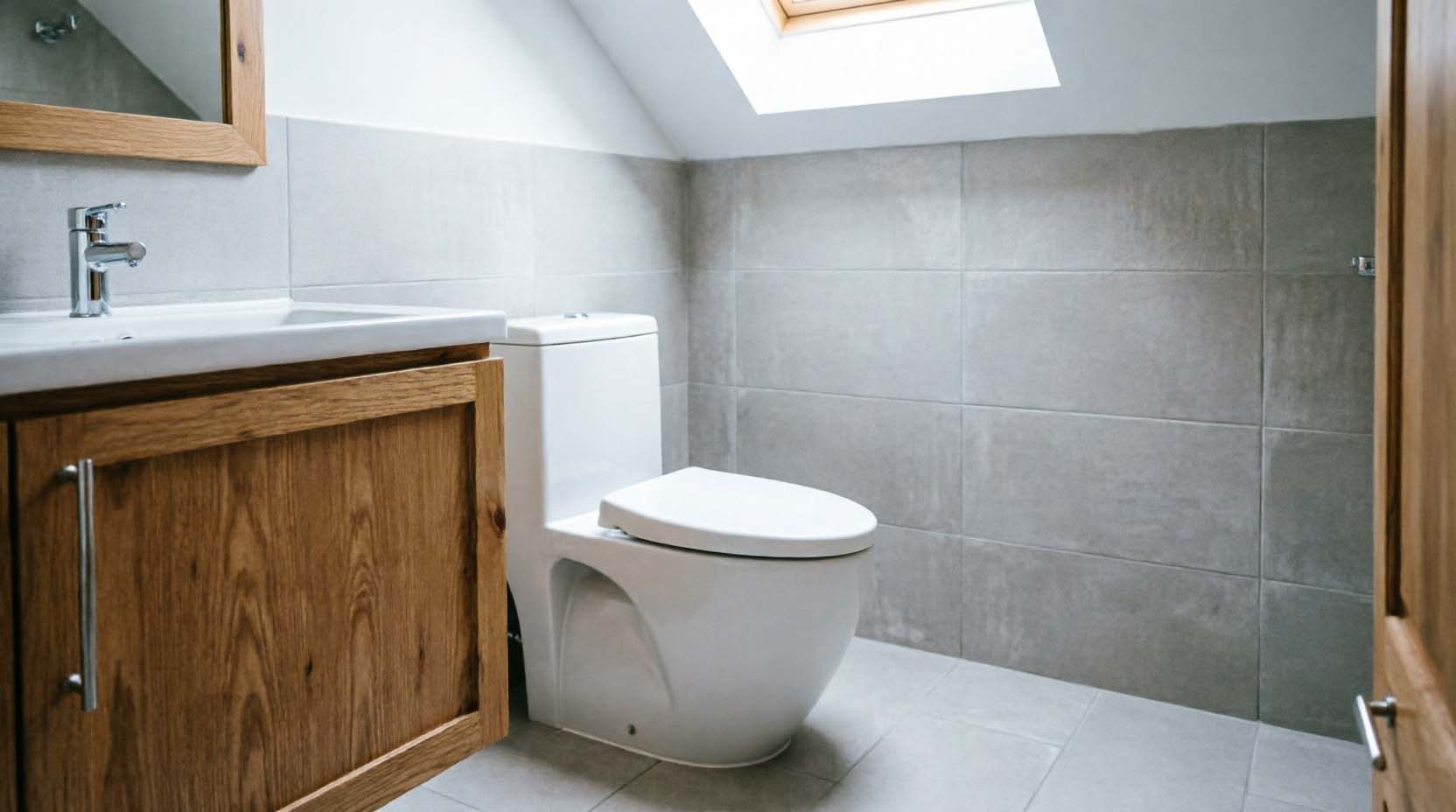
Measure your rough-in before you do anything else. That single number, the distance from the wall to the center of your drain bolts, eliminates most of the toilets on the market before you even think about height or flush type. Get that right, then match bowl height to your household and flush performance to your water bill, and you'll land on a toilet that fits the first time.
This guide walks through that framework step by step, so you don't end up with a toilet that overlaps your door swing or needs two flushes to actually work.
Rough-In Measurement: The Number That Decides Everything
A rough-in is the distance from the finished wall behind the toilet to the center of the two closet bolts holding it to the floor. Not the baseboard. Not the trim. The wall itself.
Get this wrong and nothing else in this guide matters, because the toilet simply won't fit the space.
Standard rough-ins come in 10, 12, or 14 inches. The 12-inch rough-in covers roughly 90% of North American homes built after the 1950s, so it's the default assumption in most big-box stores. Older homes, especially pre-1950s builds, are more likely to have a 10-inch or 14-inch rough-in, so measure yours directly instead of assuming.
How to measure it correctly:
- Measure from the finished wall (not the baseboard trim) to the center of the rear closet bolt
- Round to the nearest whole number. Most manufacturers only make 10-, 12-, and 14-inch models
- Measure twice if you're replacing an existing toilet. Old installations sometimes drift from standard spacing
What Happens If You Get the Rough-In Wrong
A homeowner mid-remodel orders online without measuring, gets a 12-inch rough-in toilet for a 10-inch space, and the tank ends up overlapping the door swing by two inches. That's not a rare story. It's the single most common return reason toilet retailers report.
Signs you measured wrong or bought the wrong size:
- The tank hits the wall or a nearby fixture when installed
- The toilet base doesn't fully cover the flange, leaving a visible gap
- The toilet sits crooked or won't seat flush against the floor
A too-large rough-in toilet can sometimes be installed with an offset flange as a workaround, though this isn't ideal and can affect the seal quality. A too-small rough-in almost never works without actual plumbing changes. Measure first, every time.
Comfort Height vs Standard Height: Which One Fits Your Household
Comfort height, also called "right height" or ADA height, puts the rim at 17 to 19 inches off the floor. Standard height sits at 14 to 15 inches. That three- to four-inch difference sounds small until you're the one sitting down and standing up on it multiple times a day.
The ergonomic logic is simple. A comfort height toilet sits closer to standard chair height, which reduces knee and hip strain during the sit-to-stand transition. ADA-compliant installations specifically require the 17 to 19 inch range for this reason.
For a household with anyone over 60, anyone recovering from hip or knee surgery, or anyone over 6 feet tall, comfort height reduces joint strain on every single use, for years. That's not a marginal comfort upgrade. It's a daily-use ergonomic difference.
5 Signs You Should Choose Comfort Height Over Standard:
- Anyone in the household is over 60 or has mobility limitations
- A family member is recovering from joint surgery or has arthritis
- Anyone using the bathroom is taller than 6 feet
- You're renovating specifically for aging-in-place
- The bathroom will need to meet ADA guidelines for a rental or care situation
Bowl Shape: Elongated vs Round
Elongated bowls have an oval front-to-back shape and are now the standard pairing with most comfort height models. Round bowls save 2 to 3 inches of floor space, which matters in a tight half-bath.
|
Factor |
Elongated Bowl |
Round Bowl |
|
Comfort |
More seating surface, generally preferred |
Adequate, less surface area |
|
Footprint |
Standard, about 30 inches from wall to bowl front |
2 to 3 inches shorter |
|
Best for |
Most bathrooms, comfort height installs |
Small half-baths, tight clearances |
|
Typical cost difference |
Baseline |
Often $10 to $30 less |
If your bathroom is under 30 square feet or you've got less than 30 inches of clearance in front of the bowl, measure before you assume elongated will fit.
Flush Performance: What MaP Scores Actually Mean
MaP stands for Maximum Performance Testing, an independent, third-party test that measures how many grams of solid waste a toilet clears in a single flush. It's the closest thing to a real-world performance number the industry has, and it's a metric most buying guides skip entirely.
Here's why that matters more than GPF alone. Two toilets can both advertise 1.28 GPF. One might have a MaP score of 1,000 grams. The other might score 250. The second one will need a second flush on a regular basis, which quietly doubles its real-world water use and erases any savings the low GPF rating promised.
Look for a MaP score of 500 grams or higher for confident single-flush performance in a typical household. Scores below 350 grams signal a real risk of needing to double-flush regularly, especially in households with more than two people using that bathroom daily.
You can typically find MaP scores on manufacturer spec sheets, or cross-reference them through MaP Testing's public database, which lists results across most major toilet lines sold in North America.
Trapway Design and Flush Type
A wider, fully glazed trapway (the internal passage waste travels through) clogs less often than a narrower, rough-surfaced one. Glazing matters here in the same way a smooth drainpipe clears faster than a rough one: less surface for waste to catch on.
|
Flush Type |
Noise |
Power |
Maintenance |
Best For |
|
Gravity flush |
Quiet |
Standard, relies on water weight |
Low, fewer moving parts |
Most residential bathrooms |
|
Pressure-assisted |
Noticeably louder |
Stronger, uses compressed air |
Slightly higher, more components |
High-use or commercial-style homes |
Gravity flush is the standard choice for most homes, and it's quiet enough for bedrooms nearby. Pressure-assisted delivers more clearing power, but the flush sound is genuinely loud, closer to an airplane lavatory than a home bathroom.
Water Use and GPF Regulations: What WaterSense Actually Guarantees
Federal law has capped new toilets at 1.6 GPF (gallons per flush) since 1994. WaterSense-certified models go further, using 1.28 GPF or less, but here's the part most shoppers miss: WaterSense certification also requires the toilet to meet minimum flush performance standards. It's not just a low-flow marketing sticker. It's a performance-verified label.
Dual-flush models typically offer 1.6 GPF for solid waste and 0.8 to 1.1 GPF for liquid waste, which averages out to roughly 1.28 GPF per use across a typical household's mix of flushes.
A family of four switching from an old 3.5 GPF toilet, common in pre-1994 construction, to a 1.28 GPF WaterSense model can cut toilet-related water use by roughly 60%. On a metered water bill, that adds up over a full year, though the exact dollar savings depends on your local water rate.
What WaterSense Certification Actually Checks
A WaterSense label means the toilet uses 1.28 GPF or less AND has passed independent performance testing for waste removal, not just water reduction. A toilet can be low-flow without this label. WaterSense means low-flow that still works.
Single Flush vs Dual Flush: Is the Extra Button Worth It
Dual flush saves more water on average across a household's daily use. It also has more mechanical parts, which means more components that can wear out or need adjustment over a decade of daily use.
Choose dual flush if:
- Your household is genuinely water-bill or drought conscious
- You don't mind occasional mechanism troubleshooting down the line
- You're comfortable paying a modest premium upfront for long-term savings
Choose single flush if:
- You want the simplest, lowest-maintenance option
- Your water rates are low enough that the savings won't offset the added complexity
The Master Toilet Selection Reference Table
|
Use Case |
Recommended Height |
Recommended Flush Type |
Target MaP Score |
GPF Range |
|
Aging-in-place / mobility |
Comfort (17-19 in) |
Gravity |
500+ |
1.28 |
|
Standard family bathroom |
Comfort or Standard |
Gravity |
500+ |
1.28 |
|
Small half-bath |
Standard, round bowl |
Gravity |
400+ |
1.28 to 1.6 |
|
High-use / commercial-style |
Comfort |
Pressure-assisted |
600+ |
1.28 |
|
Drought-region / water-bill focused |
Comfort or Standard |
Dual flush |
500+ |
1.28 average |
|
Guest bathroom (light use) |
Standard |
Gravity |
350+ |
1.28 to 1.6 |
Other Features That Matter Beyond Height and Flush
A handful of secondary specs decide whether a toilet is pleasant to live with for the next 10 to 15 years.
Quick Spec Checklist:
- Seat type: Soft-close is close to standard now, but confirm it's included rather than sold separately
- Trapway style: Skirted (smooth, enclosed sides) is easier to clean but usually costs $50 to $100 more than an exposed trapway
- Construction: One-piece has fewer seams to trap grime but is heavier and pricier to install. Two-piece is cheaper and easier to maneuver into tight bathrooms
- Finish standardization: Confirm the seat, tank lid, and bowl are all the same white shade. Mismatched "cotton white" and "bright white" finishes are a common complaint
Who Should NOT Buy a High-Efficiency or Comfort Height Toilet
Most buying guides skip this section. It's the one that actually prevents a bad purchase.
- Households with young children in toilet training: A taller comfort height bowl can make independent use genuinely harder for a toddler, not easier. Consider a standard height model for a child-focused bathroom, at least until they're older.
- Extremely tight bathrooms: If you've got less than 30 inches of clearance in front of the bowl, an elongated comfort height model may not physically fit. Measure your space before assuming it's an upgrade you can make.
- Homes on well water with low pressure: Pressure-assisted flush toilets need adequate incoming water pressure to work properly. Verify your well system's output before buying one, since low pressure can mean the pressure-assist tank doesn't fully charge between flushes.
- Noise-sensitive households: If a bedroom shares a wall with the bathroom, or you live in a basement apartment with shared walls, pressure-assisted flush is genuinely loud. Gravity flush is the better fit regardless of its slightly lower clearing power.
Chasing the lowest GPF number alone is backwards logic here. A 1.1 GPF toilet with a weak MaP score will cost more in water over time through repeated double-flushing than a 1.28 GPF toilet that clears everything in one pass.
Final Verdict: How to Match Your Toilet to Your Actual Bathroom
Three scenarios cover most households:
- Aging-in-place household: comfort height, elongated bowl, gravity flush, MaP score of 500 or higher. Prioritize the sit-to-stand ergonomics over water savings.
- Small bathroom remodel: measure your clearance first, then decide between standard height with a round bowl or comfort height if space allows. Don't assume elongated fits without measuring.
- Water-bill-conscious family: dual flush, WaterSense certified, MaP score of 500 or higher. Confirm the mechanism warranty length since dual-flush units have more moving parts.
Run PickSmartly's Measure, Match, MaP rule before you buy. Measure your rough-in first, since it eliminates most unfit options instantly. Match the bowl height to your household's actual bodies, not an assumed default. Then check the MaP score before you check the price. A toilet that fits and clears waste in one flush every time is worth more than one that's ten dollars cheaper and needs a second flush every week.
Frequently Asked Questions
How do I know my rough-in measurement?
Measure from the finished wall behind the toilet to the center of the rear closet bolt, not the baseboard. Round to the nearest whole number. Most homes built after the 1950s use a 12-inch rough-in, but older homes can vary, so measure directly rather than assuming.
Will comfort height feel too tall for kids?
It can. Comfort height sits at 17 to 19 inches, which is noticeably taller than standard height for a child still toilet training. If young children will use the bathroom independently and often, a standard height model may be the more practical choice for now.
Do low-flow toilets actually clog more?
Not if the MaP score is strong. GPF alone doesn't determine clearing power. A 1.28 GPF toilet with a MaP score of 500 or higher clears waste as reliably as older high-flow models. The clogging complaints usually trace back to a low MaP score, not the GPF rating itself.
Is dual flush worth the extra cost and complexity?
For water-bill or drought-conscious households, generally yes. It saves more water on average but has more mechanical parts that can need adjustment over a decade of use. If simplicity matters more to you than incremental savings, single flush is the lower-maintenance choice.
Will an elongated bowl even fit my small bathroom?
Maybe not. Elongated bowls need roughly 30 inches of clearance from the wall to the bowl front. If your space is tighter than that, a round bowl saves 2 to 3 inches and is the safer fit for a small half-bath.
What's the difference between a one-piece and two-piece toilet?
A one-piece toilet has the tank and bowl fused into a single unit, which means fewer seams for grime to collect in, but it's heavier and pricier to install. A two-piece toilet is cheaper, lighter, and easier to maneuver into tight bathrooms during installation.
Do all new toilets meet WaterSense standards?
No. All new toilets sold in the US must meet the federal 1.6 GPF cap, but WaterSense certification is a separate, voluntary standard requiring 1.28 GPF or less plus verified flush performance. Check for the WaterSense label specifically if water efficiency is a priority.