How to Choose a Generator: Sizing, Inverter vs Conventional
Sizing a generator comes down to one formula: add up your running watts, add the single highest starting watt spike, then multiply by 1.2 for a safety buffer. That number tells you what wattage class to shop in. From there, whether you need inverter or conventional power depends on noise tolerance, budget, and whether you're running sensitive electronics or raw power tools.
This guide walks through the exact math, breaks down when each generator type earns its price tag, and covers the safety thresholds that actually matter. No vague "buy the biggest one you can afford" advice here.
What's the Difference Between Inverter and Conventional Generators?
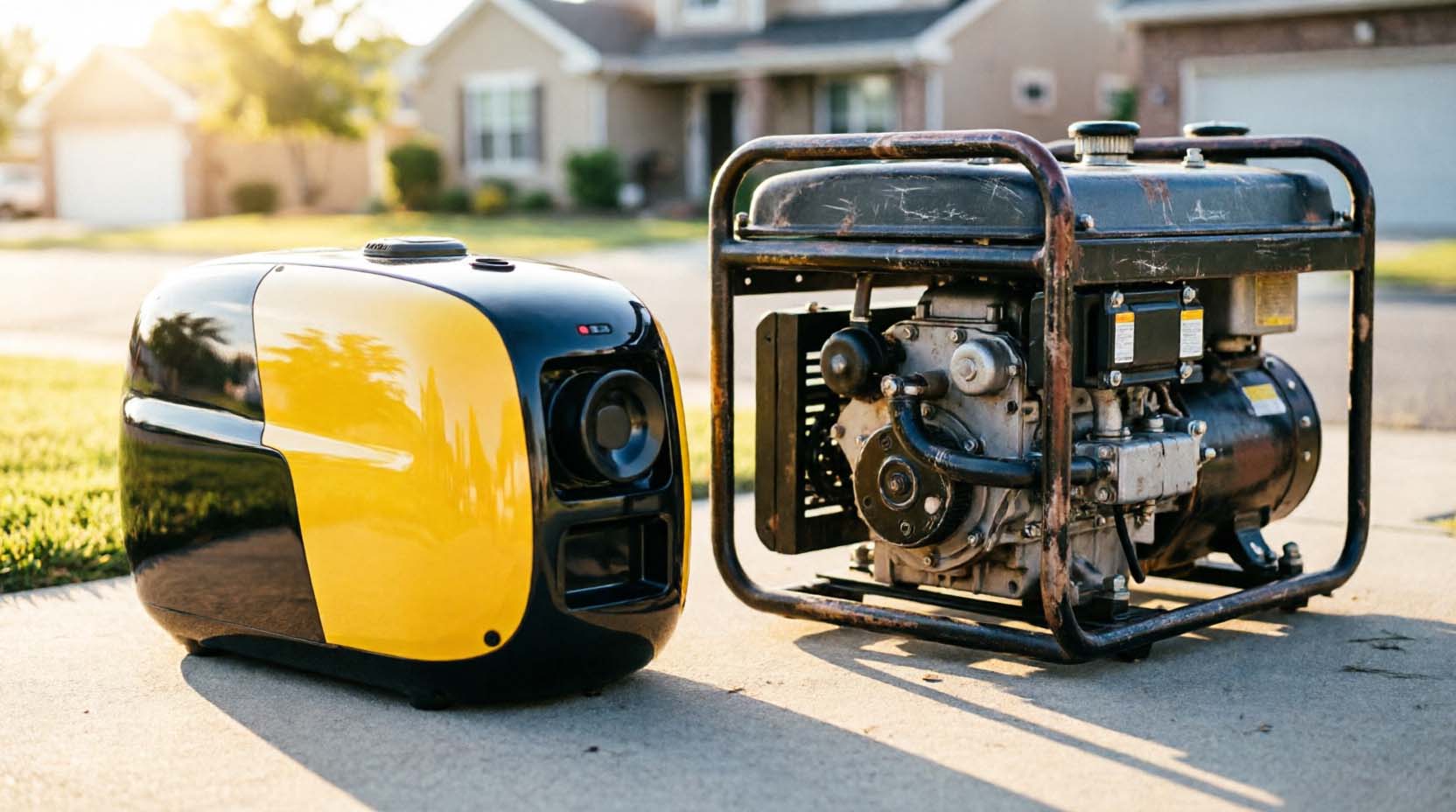
A conventional generator runs its engine at a constant RPM, usually 3,600, regardless of how much power you're pulling. It's a simple, mechanical approach that produces raw AC power.
An inverter generator runs at variable engine speed and passes power through electronic circuitry before it reaches your outlet. That process smooths the output into a cleaner, more stable sine wave.
That distinction drives nearly every other decision in this guide. Conventional units typically run 3,000 to 10,000+ watts and cost less per watt of output. Inverter units typically run 1,000 to 4,500 watts standalone, with parallel-capable models stacking to roughly 7,000 to 9,000 watts combined, and cost 1.5 to 2.5 times more per watt than conventional units.
Picture it this way. A conventional generator is like a diesel truck engine, loud and strong, built to move heavy loads without finesse. An inverter generator is more like a hybrid engine, quieter and more efficient, but with a lower ceiling on raw output.
A homeowner running a sump pump and refrigerator during a storm mostly needs raw output. That's a strong conventional candidate. Someone charging a laptop and running a CPAP machine while camping needs stable, clean power. That's an inverter candidate.
|
Factor |
Conventional |
Inverter |
|
Wattage range |
3,000 to 10,000+ watts |
1,000 to 4,500 watts (parallel to ~9,000 W) |
|
Noise at 25% load |
64 to 78 decibels |
51 to 61 decibels |
|
Clean power (low THD) |
No, rougher waveform |
Yes, safe for electronics |
|
Weight and portability |
Heavier, less portable |
Lighter, compact |
|
Price per watt |
Lower |
Higher |
|
Best for |
Whole-home backup, job sites |
Camping, RVs, sensitive electronics |
How to Choose a Generator: The Wattage Sizing Method
This is the part most buying guides skip or oversimplify. Get this math right and everything else falls into place.
Step 1: List every appliance you need to power simultaneously
Sizing isn't about your entire home's total appliance load. It's about what runs at the same time during an outage. Most households only need a handful of circuits running together, not everything at once.
Here's a reference chart for common household loads:
|
Appliance |
Running Watts |
Starting Watts |
|
Refrigerator |
600 to 800 |
1,200 to 2,200 |
|
Sump pump |
800 to 1,050 |
1,300 to 2,150 |
|
Window AC (10,000 BTU) |
1,200 |
3,600 |
|
Furnace fan (1/3 HP) |
700 |
1,400 |
|
Microwave |
1,000 |
Minimal |
|
Well pump (1/2 HP) |
1,000 |
2,100 |
|
Laptop and phone charging |
50 to 100 combined |
Minimal |
Step 2: Understand running watts vs starting watts
This is the single biggest source of buyer regret in this category. Motor-driven appliances, think compressors, pumps, and AC units, draw a short surge when they kick on. That spike typically runs 2 to 3 times their running wattage and lasts only 1 to 3 seconds.
A generator sized only for running watts will stall or trip a breaker the moment that fridge compressor cycles on. It's not a defect. It's physics catching up to an undersized purchase.
Rule of thumb: add up running watts for everything you'll use simultaneously. Then add only the single highest starting-watt spike from your list, not every appliance's starting watts stacked together. In real-world use, motors rarely all fire at the exact same instant.
Scenario anchor: running a fridge (700W) plus a sump pump (900W) plus a few lights (200W) totals 1,800 running watts. If the sump pump's starting spike is 1,900W, your real target is 1,800 + 1,900, which lands at 3,700 watts. Not 1,800. That gap is exactly where underpowered generators fail.
Step 3: Add a safety buffer
Add 20 to 25% above your calculated total. Running a generator continuously at its maximum rated capacity shortens engine life and leaves zero headroom if you need to plug in one more device.
PickSmartly's Watts-Plus-Spike Rule: (Total running watts + highest single starting watt spike) x 1.2 = your target generator wattage.
Using the example above: (1,800 + 1,900) x 1.2 = 4,440 watts. That's your shopping number. Anything meaningfully below it risks stalling under load. Anything way above it means you're paying for capacity you'll rarely use.
Generator Types Beyond Portable Inverter and Conventional
Two other categories round out the field, and they matter for specific situations.
- Standby (whole-house) generators run 7,000 to 20,000+ watts, are installed permanently with an automatic transfer switch, and typically cost $5,000 to $12,000 installed. Best for homeowners who want outages to be a non-event. Drawback: a major upfront investment compared to portable options.
- Dual-fuel portable generators run on gasoline or propane, giving you flexibility when one fuel source runs short during a regional shortage. Drawback: expect roughly 10 to 15% efficiency loss when running on propane compared to gasoline.
Fuel Type and Runtime: What to Actually Expect
Fuel choice changes your runtime math more than most spec sheets let on.
A midsize gasoline conventional generator, in the 5,000 to 7,500 running watt range, typically runs 8 to 10 hours per tank at 50% load. Push that same unit to full rated load and expect runtime to drop by 30 to 40%. Manufacturer runtime figures almost always reflect the lighter load, not the heavier one, so treat the advertised number as a best-case scenario.
Stored gasoline is another overlooked issue. Fuel left sitting longer than 30 days without a stabilizer starts to degrade and can clog carburetors, which is a common reason generators fail to start during the exact emergency they were bought for.
Scenario anchor: a homeowner running just a fridge and a few lights at roughly 25% load during a 3-day outage will stretch fuel considerably further than one running a window AC and well pump at 80% load. Know your real load percentage before estimating how much gas to stockpile.
Noise Levels: A Real Factor Most Guides Skip
Noise isn't just an annoyance. It's often a hard limit.
Inverter generators typically run 51 to 61 decibels at 25% load, roughly the volume of normal conversation. Conventional generators typically run 64 to 78 decibels at similar load, comparable to a running vacuum cleaner or louder.
That gap matters more than the raw numbers suggest, since decibels are measured on a logarithmic scale. A jump from 60 to 75 decibels isn't 25% louder. It's perceived as roughly twice as loud to the human ear.
Most campgrounds cap generator noise at 60 decibels. If you're buying for camping or RV use, that threshold alone rules out most conventional units.
|
Sound Level |
Comparable Reference |
|
51 to 61 dB |
Normal conversation |
|
64 to 78 dB |
Vacuum cleaner to loud traffic |
|
60 dB cap |
Typical campground noise limit |
Generator Safety: Non-Negotiable Thresholds
This section isn't optional reading. Get it wrong, and the consequences are severe.
- Never run a generator inside a garage, even with the door open. Carbon monoxide can reach lethal concentrations within minutes in an enclosed or semi-enclosed space.
- Position generators at least 20 feet from windows, doors, and vents, with the exhaust pointed away from the home.
- Install a battery-backup carbon monoxide detector inside the home regardless of where the generator sits outside.
- For whole-home backup connected to household wiring, use a properly installed transfer switch.
- Never back-feed a generator into your home's panel through a regular wall outlet. This can electrocute utility line workers repairing the grid and violates electrical code in most jurisdictions.
Common Mistakes to Avoid When Choosing a Generator
- Sizing only for running watts and ignoring the starting watt spike
- Buying based on price per watt alone without factoring in noise or portability
- Skipping fuel stabilizer on gasoline stored longer than a month
- Running a generator continuously at 100% of its rated load
- Assuming a standard outlet can safely back-feed a home's electrical panel
Buyer Decision Checklist
- Listed every appliance you'd run simultaneously during an outage
- Calculated total running watts using the appliance chart above
- Identified your single highest starting watt spike
- Applied the Watts-Plus-Spike Rule to get your target wattage
- Decided if noise limits (campground or neighbors) rule out conventional units
- Confirmed a safe outdoor placement at least 20 feet from windows and doors
- Installed or verified a battery-backup CO detector inside the home
Who Should Skip Inverter Generators
If you mainly need to run high-wattage tools or a well pump on a tight budget, inverter units aren't the right call. They top out around 4,500 watts standalone and cost significantly more per watt than conventional models. When raw output is the priority and noise isn't a concern, conventional delivers more capacity for the money.
Who Should Skip Conventional Generators
RV owners, campers near other campsites, and anyone running sensitive electronics like laptops or medical equipment should think twice about conventional units. They produce a rougher power waveform with higher total harmonic distortion, which can damage sensitive electronics over time without a separate power conditioner. Their noise output also tends to exceed campground limits outright.
Final Word
Sizing a generator isn't guesswork once you have the formula. Add your running watts, add the biggest starting spike, multiply by 1.2, and you've got a real number to shop with.
From there, the inverter-versus-conventional call comes down to what you're actually powering. Sensitive electronics and quiet camping trips point toward inverter. Raw output on a budget points toward conventional. Neither one is universally "better," despite what most spec sheets imply.
Run the math before you buy. It's the difference between a generator that carries you through the next outage and one that trips a breaker the moment the fridge compressor kicks on.
Frequently Asked Questions
What size generator do I need to run my house?
Use the Watts-Plus-Spike Rule: add your simultaneous running watts, add the single highest starting watt spike, then multiply by 1.2. Most households running a fridge, sump pump, and basic lighting land somewhere between 3,500 and 5,000 watts.
Is an inverter generator worth the extra money?
It depends on your priorities. If you need quiet operation or you're powering sensitive electronics, yes. If you mainly need raw power for tools or appliances and noise isn't a concern, a conventional unit gets you more wattage per dollar.
Can a generator run my refrigerator and AC at the same time?
Only if you've sized for both units' combined running watts plus whichever has the higher starting spike. A 10,000 BTU window AC alone can spike to 3,600 starting watts, so check your total against your generator's rated capacity before assuming it'll handle both.
How long can you run a generator continuously?
Most portable generators are rated for continuous use as long as fuel and oil are maintained, but running at 100% rated load continuously shortens engine life. Keeping load at or below 80% of rated capacity is a safer long-term practice.
Is it safe to run a generator in the rain?
Not without protection. Use a generator tent or canopy rated for ventilation, and never run a generator in standing water or under direct rain exposure without one. Wet electrical components create a real shock and fire risk.
How many watts does a portable generator need for camping?
Most camping needs- lights, a small fridge, phone charging, and maybe a fan- fall in the 1,000 to 2,000 watt range, well within standalone inverter generator territory.
Do I need an electrician to hook up a generator to my house?
Yes, for a transfer switch installation. A licensed electrician should handle this. Back-feeding a generator through a regular outlet is dangerous and can electrocute utility workers, and it violates code in most areas.